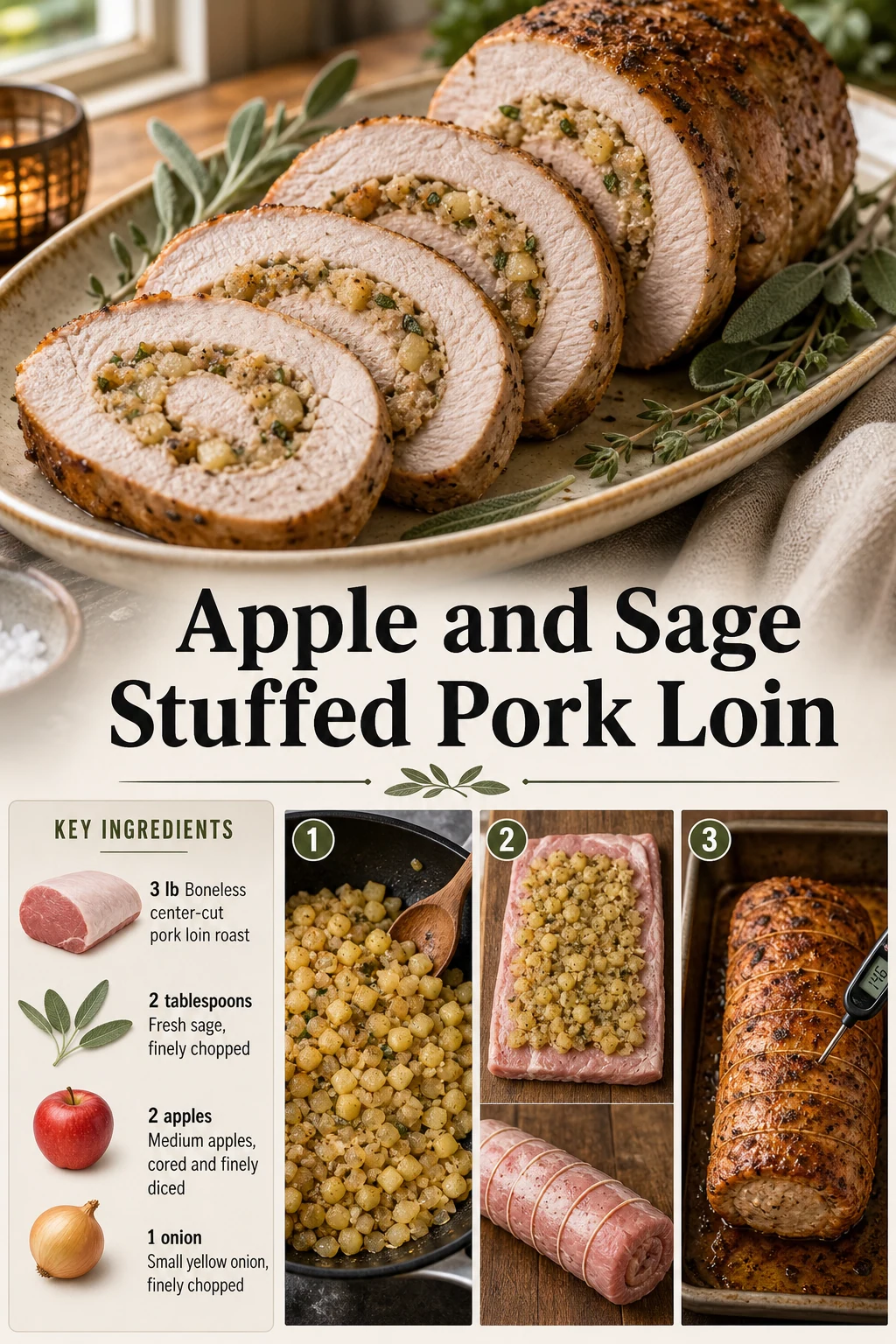
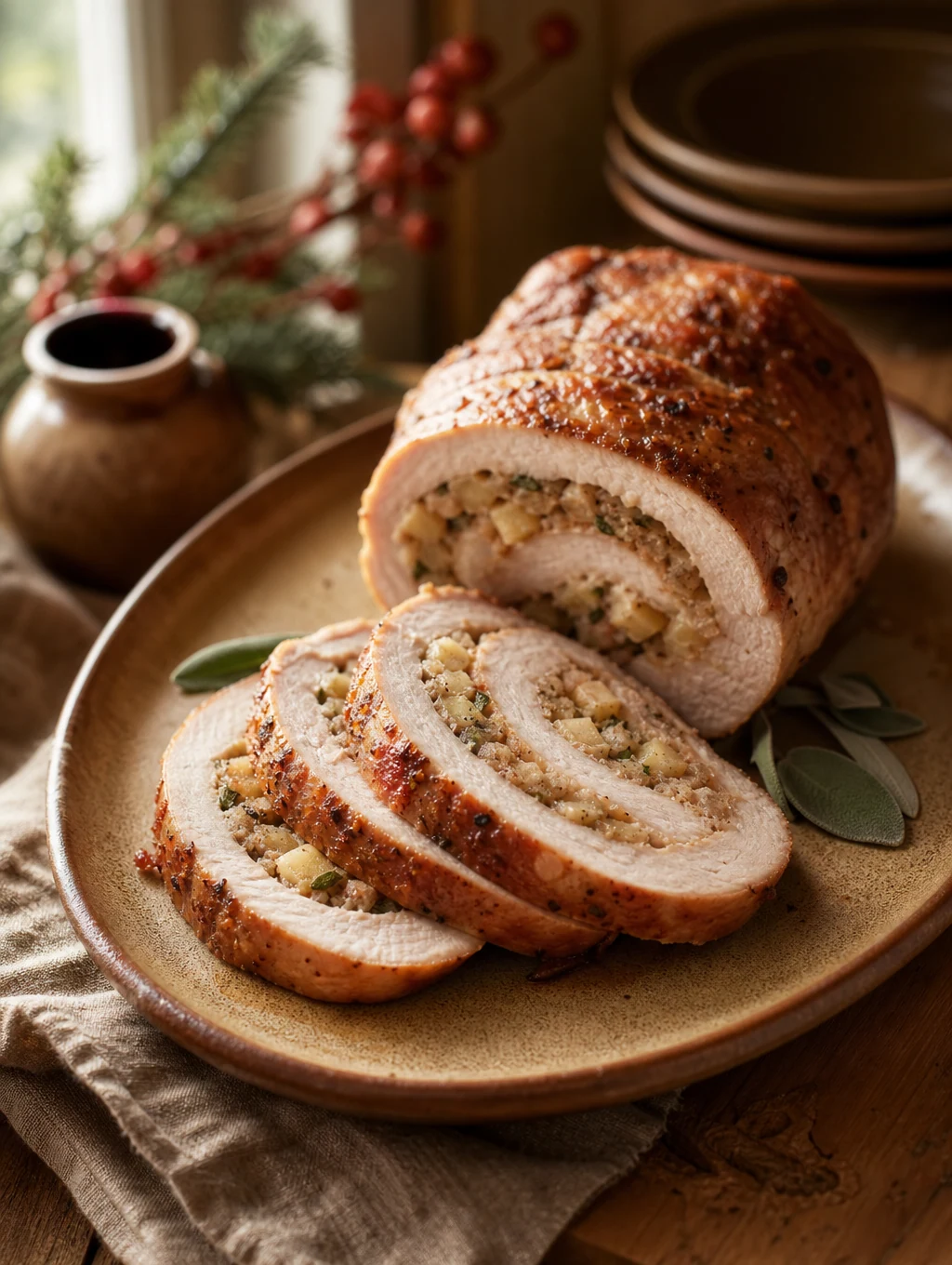
Apple and sage stuffed pork loin is a sliced roast with a thin savory-fruit filling running through the center. This proposed version butterflies a boneless center-cut loin, rolls it around softened apple and onion with fresh sage and breadcrumbs, then roasts it as one tied piece. A thermometer—not a promise that every three-pound roast finishes at the same minute—must guide the center checks. The filling, timing, moisture and yield have not been kitchen-tested.
Jump to ingredients · Jump to method
What makes this a stuffed loin rather than a glazed roast?
The apples and sage sit inside a rolled sheet of pork, not just in a pan around it. Cook the diced fruit with onion and butter until softened and much of its liquid cooks away; breadcrumbs bind the filling into a spreadable layer. Cooling it briefly makes rolling more manageable. Tie the roast so the spiral stays in place as it cooks, leaving a border at the edges to reduce spillover.
Choose a three-pound boneless center-cut pork loin, not a small pork tenderloin. The National Pork Board’s loin guide distinguishes those cuts and gives a whole-cut pork-loin endpoint of 145°F followed by at least a three-minute rest. A filled roast adds a center-filling check. For this draft the working instruction is to verify the center of the filling reaches at least 165°F as well as the pork reaching at least 145°F, then rest the tied roast for 15 minutes. This conservative filled-roast approach and the risk of overcooking the loin must be resolved in an actual test and final official-source review.
Ingredients for six working portions
| Ingredient | Amount | Use |
|---|---|---|
| Boneless center-cut pork loin roast | 3 lb | Butterfly and roll. |
| Medium apples, cored and finely diced | 2 | Cook in filling. |
| Small yellow onion, finely chopped | 1 | Cook with apples. |
| Fresh sage, finely chopped | 2 tbsp | Fold into filling. |
| Plain dry breadcrumbs | ½ cup | Bind cooked fruit. |
| Unsalted butter | 2 tbsp | Filling skillet. |
| Olive oil | 1 tbsp | Rub roast exterior. |
| Fine salt | 1½ tsp, divided | ½ tsp filling, 1 tsp exterior. |
| Black pepper | ½ tsp, divided | ¼ tsp filling, ¼ tsp exterior. |
Have a large skillet, sharp knife, food-safe work surface, kitchen twine, rimmed roasting pan and food thermometer ready. Plain breadcrumbs contain wheat unless the selected product and all other ingredients establish a different dietary claim. Butter contains milk. The filling needs to be cooked before it touches raw pork, then it must be treated as part of the raw-meat assembly; tasting the filling after contact or using its pre-cooked status to skip the center check would be inappropriate.
Cook the filling, roll and roast
- Soften and cool the filling. Heat oven to 350°F. Melt two tablespoons unsalted butter in a large skillet and cook one finely chopped small onion and two cored, finely diced medium apples for about ten minutes, stirring until softened and much moisture has evaporated. Stir in two tablespoons chopped sage, half a cup plain dry breadcrumbs, half a teaspoon of the salt and a quarter teaspoon pepper. Set aside for about ten minutes to cool while preparing the pork.
- Butterfly and tie the loin. On a clean surface, cut the three-pound boneless loin lengthwise to open it into a fairly even rectangle without slicing through. Spread the apple mixture thinly, leaving an inch around the edges. Roll tightly into a log and secure with kitchen twine at intervals. Rub exterior with one tablespoon olive oil, the remaining teaspoon salt and remaining quarter teaspoon pepper.
- Roast and measure. Place seam-side down in a rimmed roasting pan. Roast uncovered at 350°F, beginning thermometer checks well before the approximate 80-minute target. Probe the thickest pork and center of the filling separately. Continue as needed for the draft’s conservative center-filling endpoint of 165°F and at least 145°F for the pork. A thin or uneven butterfly can change the result substantially; do not use exterior color as the endpoint.
- Rest and slice. Transfer to a clean board and rest 15 minutes, which exceeds the three-minute minimum for a whole pork cut. Remove twine and slice into six working portions so each has visible apple-sage filling. Note exact oven time, temperatures and cooked weight during the kitchen test.
The estimated ledger is 30 minutes preparation and rolling, about 90 minutes cooking—ten for the filling and up to roughly 80 in the oven—and 25 additional minutes for filling to cool and the finished roast to rest, about 145 minutes overall. Some cooling overlaps meat preparation, so the schedule is deliberately conservative. It is not a guarantee that a stuffed loin will be done at 80 minutes; thermometer readings decide when to stop. If the center filling needs substantially more time than the pork, this formula or roll thickness must be redesigned before publication rather than accepting a dry roast as inevitable.
Keep the spiral neat and the loin from drying
Filling spills out: drain off excess apple liquid in the skillet and keep the layer thin with an open border. Roll opens: retie at regular intervals and set seam down. Exterior browns early: check oven placement and internal temperatures rather than guessing that dark color means cooked center. Slice tears: give it its rest and use a sharp knife after removing the twine. The apple filling’s actual volume and how evenly it distributes are key kitchen-test measurements.
A boneless loin can be cut in different thicknesses even at the same weight; ask the butcher for a center-cut piece suitable for butterflying or practice on an evenly shaped roast. A honey glaze, sausage filling or dried cranberries would change both the recipe and image and are not hidden extras. Raw pork and ready-to-eat sides need separate utensils and surfaces during assembly.
Serve with a green side
Set a slice beside Chefly’s garlic butter roasted broccoli, a separate vegetable recipe. The broccoli’s garlic butter is not part of this pork filling. In photographs, show a rolled slice with visible apple, onion and sage inside; a pork chop with apples scattered outside or a bacon-wrapped tenderloin would be the wrong dish.
Move leftovers to shallow covered containers and refrigerate promptly. Reheat thoroughly without drying the sliced pork, using a measured trial before promising a specific reheat interval. Nutrition cannot be calculated from a raw three-pound starting weight alone; trimming, cooked yield and portion shares of stuffing need recording. The byline, image rights, actual site category and native recipe fields also remain unassigned.
Stuffed loin questions
Can I use pork tenderloin?
Not as a direct substitute. It is a different, smaller cut with another butterfly geometry and roast time; the proposed card is for a three-pound boneless loin.
Does the filling have to be cooked first?
This method softens apple and onion and reduces liquid in a skillet before the filling is rolled inside. Once it touches raw pork, check its center as part of the stuffed roast rather than assuming that first sauté is enough.
Can I time it without a thermometer?
No. Weight, roll thickness and oven behavior vary; measure both pork and filling centers. The approximate roast time is only a planning estimate.
Recipe-card handoff: Nine ingredients, four stages, six unverified portions and about 145 minutes including filling cooling and meat rest. This remains a new local draft with no WordPress post, Tasty record, author or Pinterest destination.
Print
Apple and Sage Stuffed Pork Loin
- Total Time: 145 minutes
- Yield: 6 servings 1x
Description
Boneless pork loin butterflied, rolled around a pre-cooked diced apple, onion, sage and breadcrumb filling, and roasted until measured safe endpoints.
Ingredients
- 3 lb Boneless center-cut pork loin roast
- 2 apples Medium apples, cored and finely diced
- 1 onion Small yellow onion, finely chopped
- 2 tablespoons Fresh sage, finely chopped
- 1/2 cup Plain dry breadcrumbs
- 2 tablespoons Unsalted butter
- 1 tablespoon Olive oil
- 1 1/2 teaspoons Fine salt, divided
- 1/2 teaspoon Black pepper, divided
Instructions
- Heat oven to 350°F. In skillet melt 2 tbsp unsalted butter and cook 1 chopped small onion and 2 finely diced medium apples about 10 minutes until softened and most moisture has evaporated. Stir in 2 tbsp chopped fresh sage, ½ cup dry breadcrumbs, ½ tsp of the fine salt and ¼ tsp of the pepper. Set aside about 10 minutes to cool.
- Butterfly a 3-lb boneless center-cut pork loin into an even rectangle, without cutting through, and place on a clean work surface. Spread cooled apple filling thinly, leaving 1-inch border. Roll tightly, tie at intervals with kitchen twine and rub exterior with 1 tbsp olive oil, remaining 1 tsp salt and ¼ tsp pepper.
- Set seam-side down in rimmed roasting pan and roast at 350°F, beginning thermometer checks before the approximate 80-minute mark. Check thickest pork and center of filling separately; a proposed conservative filled-roast endpoint is at least 165°F in filling and at least 145°F in whole-cut pork, with an adequate rest. Oven time is only an estimate; never rely on color.
- Rest roast 15 minutes on clean board, remove twine, slice into six working portions and serve with the cooked filling. Record actual roast time, filling center temperature, moisture and cooked portion weight before publishing.
Notes
Recipe-development draft; not kitchen-tested. Timing and yield are estimates. Nutrition has not been calculated.
Additional chilling, resting or cooling time: 25 minutes, included in the total.
Untested estimate: 10-minute filling cook plus approximately 80-minute roast; 10 minutes filling cooling and 15 minutes roast rest are additional. Thermometer endpoints, not clock, govern roast.
- Prep Time: 30 minutes
- Chilling, resting or cooling: 25 minutes
- Cook Time: 90 minutes
Nutrition
- Serving Size: One of six slices/portions with filling; cooked weights pending