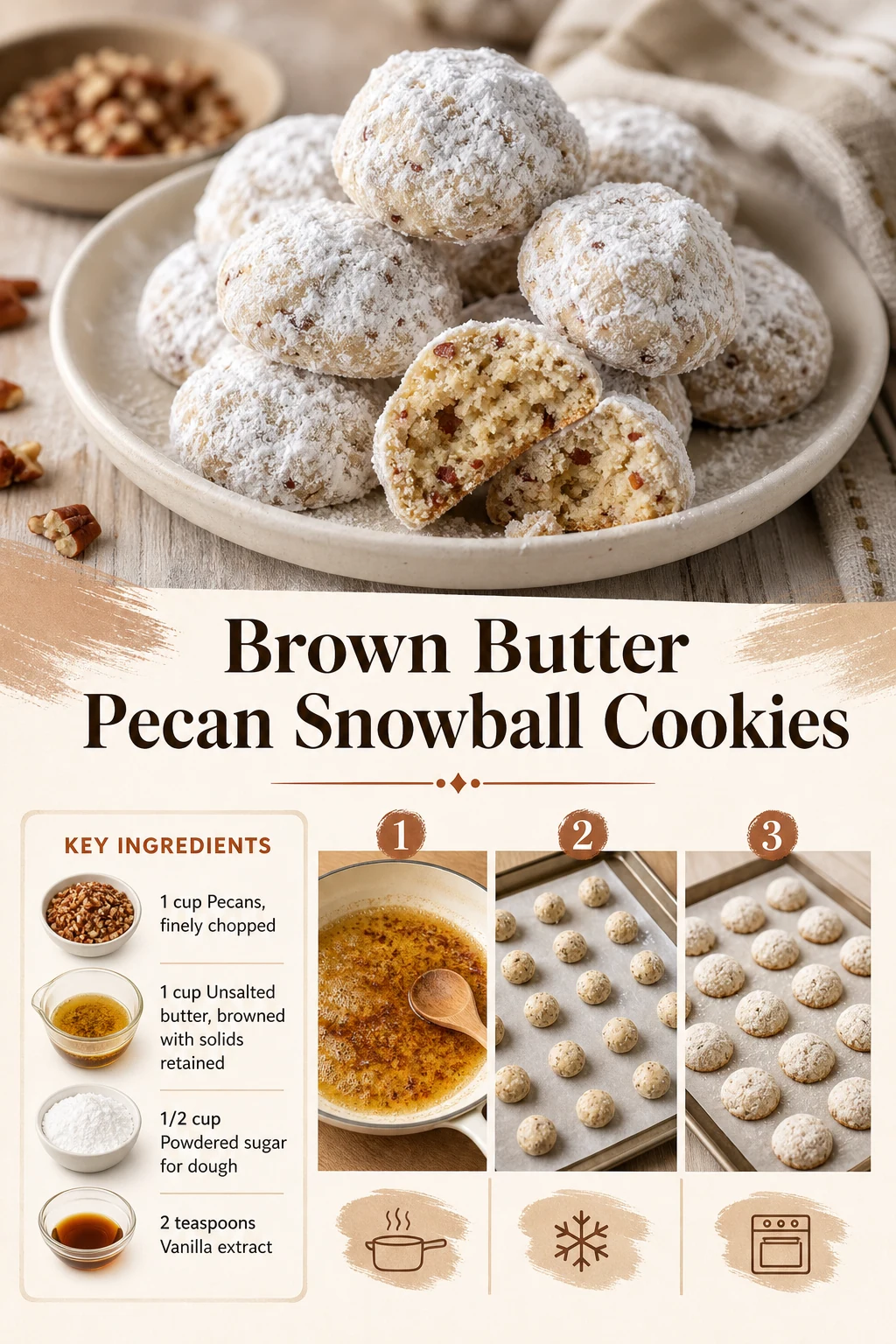
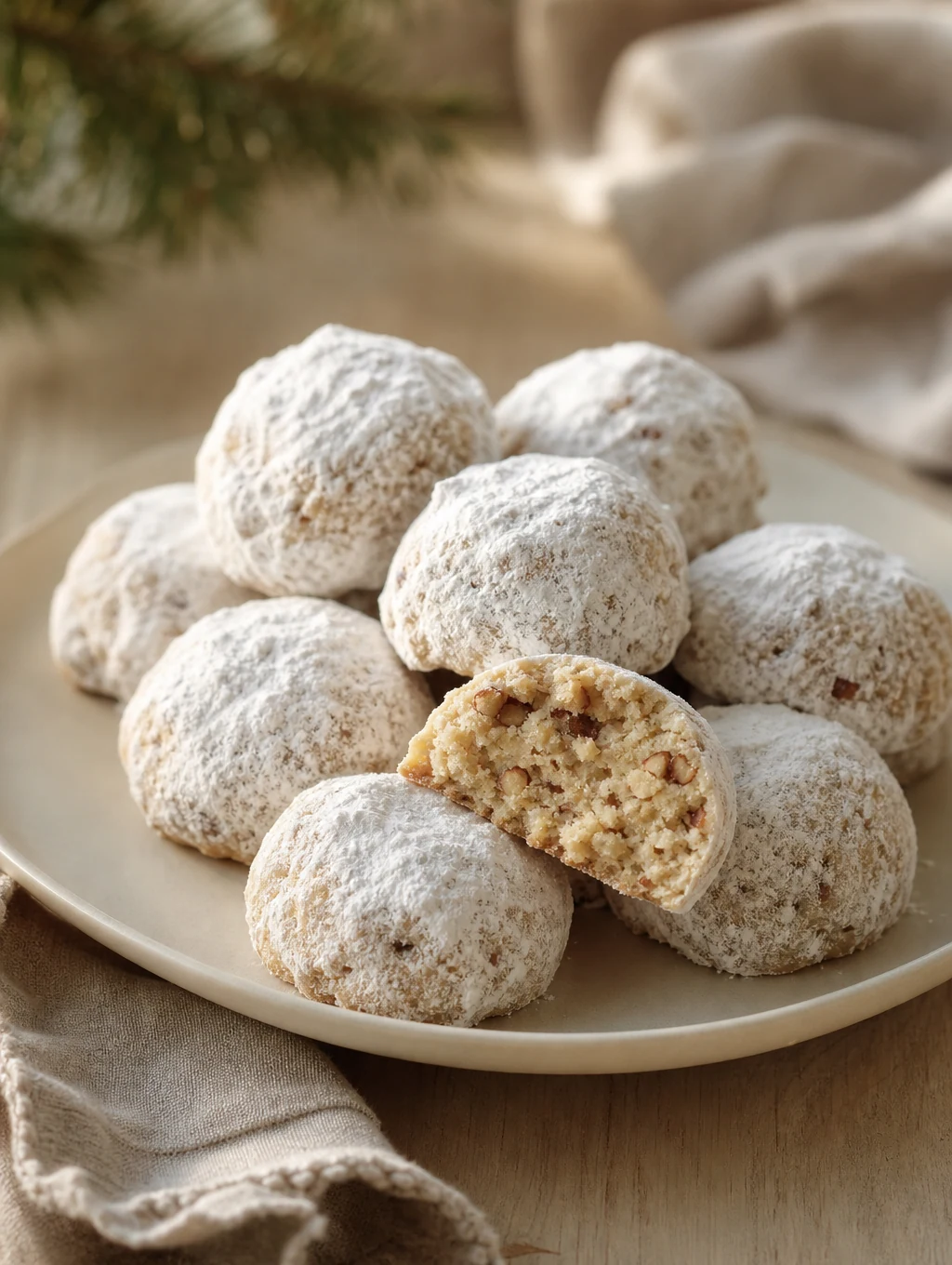
Brown butter pecan snowball cookies take the familiar powdered-sugar-coated holiday cookie in a toastier direction. Butter is browned first, cooled until workable, then mixed into a short, tender dough with finely chopped pecans. The cookies are rolled twice in powdered sugar: once when still warm enough for a light first coat, and once after they cool for a snowy finish. This is a development recipe, not a kitchen-tested promise of thirty-two perfectly round cookies; the dough texture, yield and chill time need a real bake.
Jump to ingredients · Jump to method
The brown-butter detail matters
Browned butter brings toasted-milk-solid flavor, but it is liquid and hot when it leaves the pan. Mixing it straight into flour would not behave like softened butter. Transfer it to a heat-safe bowl, scrape in the brown bits and let it cool until opaque and soft enough to stir, not rock hard. The working thirty-minute cool is only a planning estimate; room temperature and bowl shape will affect it. Do not discard the flecks at the bottom of the pan, which carry much of the browned aroma.
The pecans are chopped finely so a roughly tablespoon-sized dough portion can hold together. A large nut piece can crack a small ball, and overworked dough can become dense. Powdered sugar is measured in two separate uses: half a cup in the dough and one cup reserved for coating. Keep the coating sugar away from raw dough tools if you will use it again for the second roll.
Ingredients for an estimated 32 cookies
| Ingredient | Amount | Use |
|---|---|---|
| Unsalted butter | 1 cup (2 sticks) | Brown, retaining toasted solids; cool until soft. |
| Powdered sugar for dough | ½ cup | Mix with cooled brown butter. |
| Vanilla extract | 2 tsp | Add to butter mixture. |
| All-purpose flour | 2 cups | Measure consistently; do not taste raw dough. |
| Fine salt | ½ tsp | Balances the sugar. |
| Pecans, finely chopped | 1 cup | Fold in after flour. |
| Powdered sugar for coating | 1 cup | Reserve separately for two coats. |
Have a light-colored saucepan, heat-safe bowl, two parchment-lined baking sheets, a tablespoon measure, cooling rack and a shallow bowl for coating ready. The brown-butter stage is easier to see in a light pan. The base contains wheat, milk and tree nuts; vanilla and packaged sugar labels and cross-contact still matter when serving someone with an allergy. Do not call a flour swap gluten-free without a tested replacement and label review.
Brown, chill, bake and roll twice
- Brown the butter. Melt one cup unsalted butter in a light-colored saucepan over medium heat. Stir or swirl frequently as it foams, then watch for golden-brown flecks and a nutty aroma, approximately five to eight minutes after melting. Immediately pour into a heat-safe bowl, scraping in the brown solids. Cool about thirty minutes until opaque and soft but not hard. A dark, acrid smell means it has burned and should be remade.
- Make the dough. Stir half a cup powdered sugar and two teaspoons vanilla into the softened brown butter. Add two cups flour and half a teaspoon salt, mixing until no dry flour remains, then fold in a cup of finely chopped pecans. Press a portion in your palm; it should form a ball. Do not add an unmeasured liquid if it looks crumbly before testing the measured batch.
- Portion and chill. Measure thirty-two roughly tablespoon-sized portions and gently press each into a compact ball. Set on lined sheets and chill about thirty minutes. Heat the oven to 350°F during the end of the chill. If the batch makes a different count, record the actual yield and adjust the final copy and photo brief.
- Bake. Bake one sheet at a time on the center rack for an estimated twelve to fifteen minutes, until bottoms and edges are lightly golden and tops remain pale. Rotate the sheet if the oven browns unevenly. The working thirty-minute oven allowance covers two sequential sheets; an additional sheet will extend the total. Let cookies sit briefly until safe to handle but still warm.
- Coat and cool. Place the reserved cup of powdered sugar in a clean shallow bowl. Gently roll warm cookies in the first coat, then cool on a rack. Roll again in the remaining clean sugar after fully cool; discard any coating sugar contaminated with raw dough. Pack only after the second coat has settled.
Plan 35 active minutes for browning and mixing/portioning, 30 oven minutes for two sheets, and 60 additional minutes for butter cooling and dough chilling: 125 minutes before final cooling and second coating. The time to cool baked cookies completely is not reliably established. Therefore do not advertise 125 minutes as a packaged-and-ready elapsed time; a kitchen test must record the final cooling interval before a recipe card promises a complete total. For the local working object, an additional 30-minute baked-cookie cooling allowance is included, making 155 minutes overall.
Keep the texture delicate, not sandy
These cookies are meant to be short and crumbly, not chewy. Stop mixing once the flour disappears. If a portion cracks while rolling, press gently before adding any new ingredient. If the dough is glossy and too soft, chill until it holds; browned butter may simply not have cooled enough. If finished cookies break during the first sugar roll, wait a few more minutes and handle one at a time rather than shaking a bowlful. A very dark bottom suggests the sheet or oven is too hot; pale tops alone are normal for a snowball.
Walnuts can give a different nutty cookie but need a separate flavor and allergy review. A chocolate drizzle changes the snowball appearance and the image prompt; it is not in this base. Regular granulated sugar does not replace powdered sugar one-for-one in this tender dough. A no-nut version is a different formula because one cup pecans contributes body, not only decoration. Avoid promising a dairy-free or gluten-free variation without developing it.
Holiday serving and storage
Snowballs are useful on a mixed cookie plate because their pale coating stands apart from Chefly’s published Earl Grey cookies; those are a distinct flavored cookie, not another name for this pecan batch. For gifting, let this batch cool fully before packing between parchment. A sturdy box protects the delicate coating better than a tightly shaken bag. A tested room-temperature quality window and freeze/thaw behavior are still needed; do not print a confident shelf life on a gift tag yet.
Because flour is an untreated raw ingredient, avoid tasting the dough. The FDA raw-flour guidance explains why raw flour-containing mixtures should not be eaten and why work surfaces should be cleaned afterward. Nuts and dairy are in the base recipe; put the ingredient information with any gift rather than assuming the snowy coating reveals what is inside.
Snowball cookie questions
Why are the brown flecks in the butter important?
They are toasted milk solids and supply the brown-butter flavor. Scrape them into the bowl, but stop cooking before they turn black or smell bitter.
Why coat the cookies twice?
A first coat adheres to warm cookies and can look patchy after absorbing moisture. The second coat on cooled cookies gives the visible snowy finish. The exact amount used from the reserved cup should be noted during testing.
Can I bake both sheets at once?
The working oven allowance assumes two sheets sequentially on a center rack. Two-level baking may need different rotation and timing; test it before reducing the published total.
Recipe-card handoff: Seven ingredient lines and five stages produce an estimated 32 small cookies. The portable total counts brown-butter cooling, dough chill, sequential baking and a working cookie-cooling allowance. No numerical nutrition is calculated without tested yield, actual sugar adherence and edible portions.
Print
Brown Butter Pecan Snowball Cookies
- Total Time: 155 minutes
- Yield: 32 servings 1x
Description
Small brown-butter short cookies with finely chopped pecans, rolled twice in powdered sugar.
Ingredients
- 1 cup Unsalted butter, browned with solids retained
- 1/2 cup Powdered sugar for dough
- 2 teaspoons Vanilla extract
- 2 cups All-purpose flour
- 1/2 teaspoon Fine salt
- 1 cup Pecans, finely chopped
- 1 cup Powdered sugar for two coats
Instructions
- Brown 1 cup unsalted butter in a light pan over medium heat, stirring or swirling until golden flecks and nutty aroma, about 5–8 minutes after melting. Scrape all toasted solids into heat-safe bowl and cool approximately 30 minutes until opaque and soft.
- Stir ½ cup powdered sugar and 2 tsp vanilla into soft brown butter. Mix in 2 cups flour and ½ tsp fine salt just until no dry flour remains, then fold in 1 cup finely chopped pecans.
- Press into an estimated 32 roughly tablespoon-size compact balls on two lined sheets. Chill approximately 30 minutes; heat oven to 350°F near end of chill.
- Bake one sheet at a time on center rack approximately 12–15 minutes each until lightly golden underneath and at edges, leaving tops pale. Let stand until safe to handle yet still warm.
- Roll warm cookies gently in reserved 1 cup powdered sugar for a first coat. Cool completely on rack, working estimate 30 minutes, then roll a second time in clean remaining sugar.
Notes
Recipe-development draft; not kitchen-tested. Timing and yield are estimates. Nutrition has not been calculated.
Additional chilling, resting or cooling time: 90 minutes, included in the total.
Untested: 35 active minutes, up to 30 minutes sequential baking, 30 butter cool + 30 dough chill + estimated 30 baked-cookie cool. Record actual complete elapsed time and yield.
- Prep Time: 35 minutes
- Chilling, resting or cooling: 90 minutes
- Cook Time: 30 minutes
Nutrition
- Serving Size: One approximately tablespoon-size cookie; actual batch count and sugar adherence pending