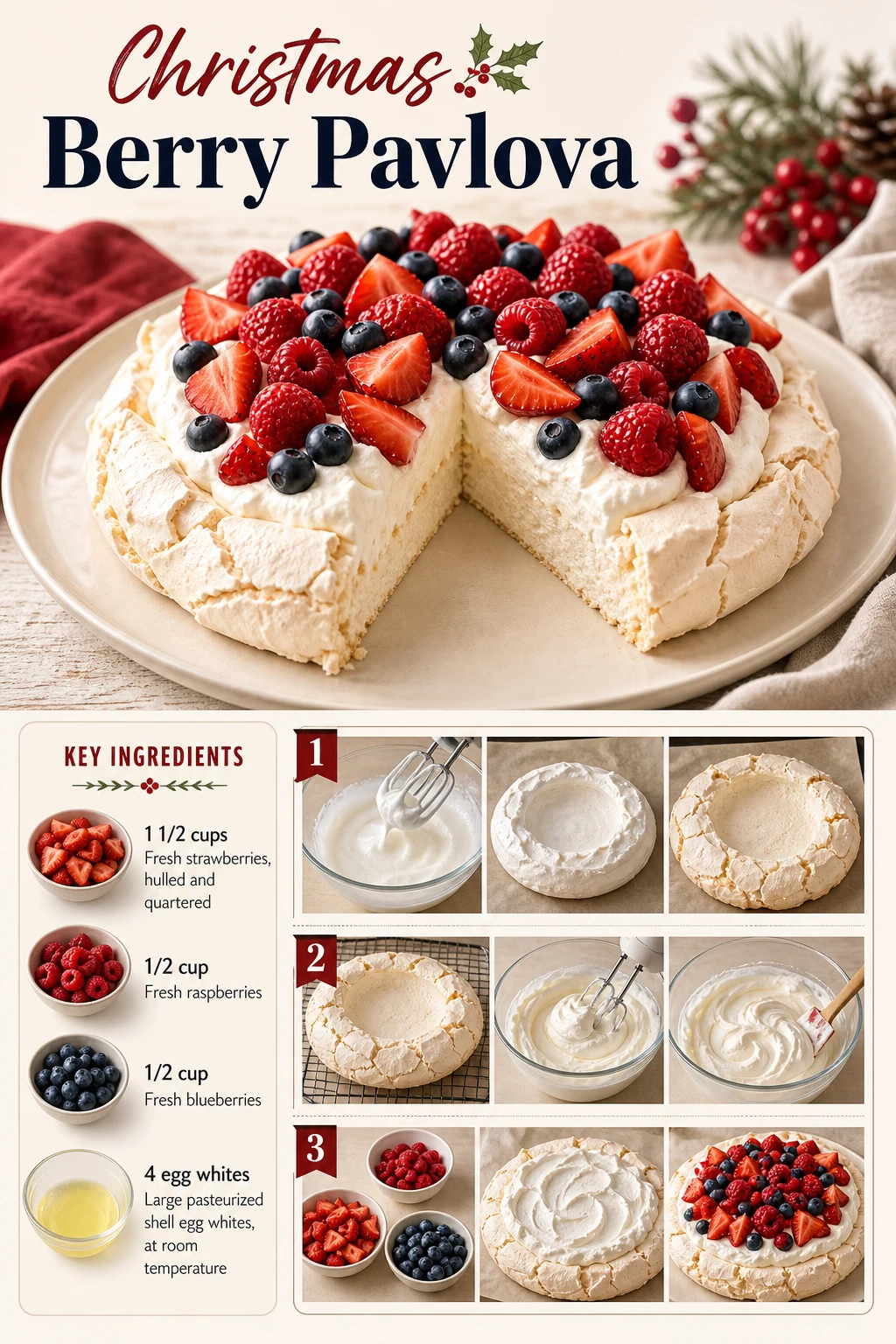
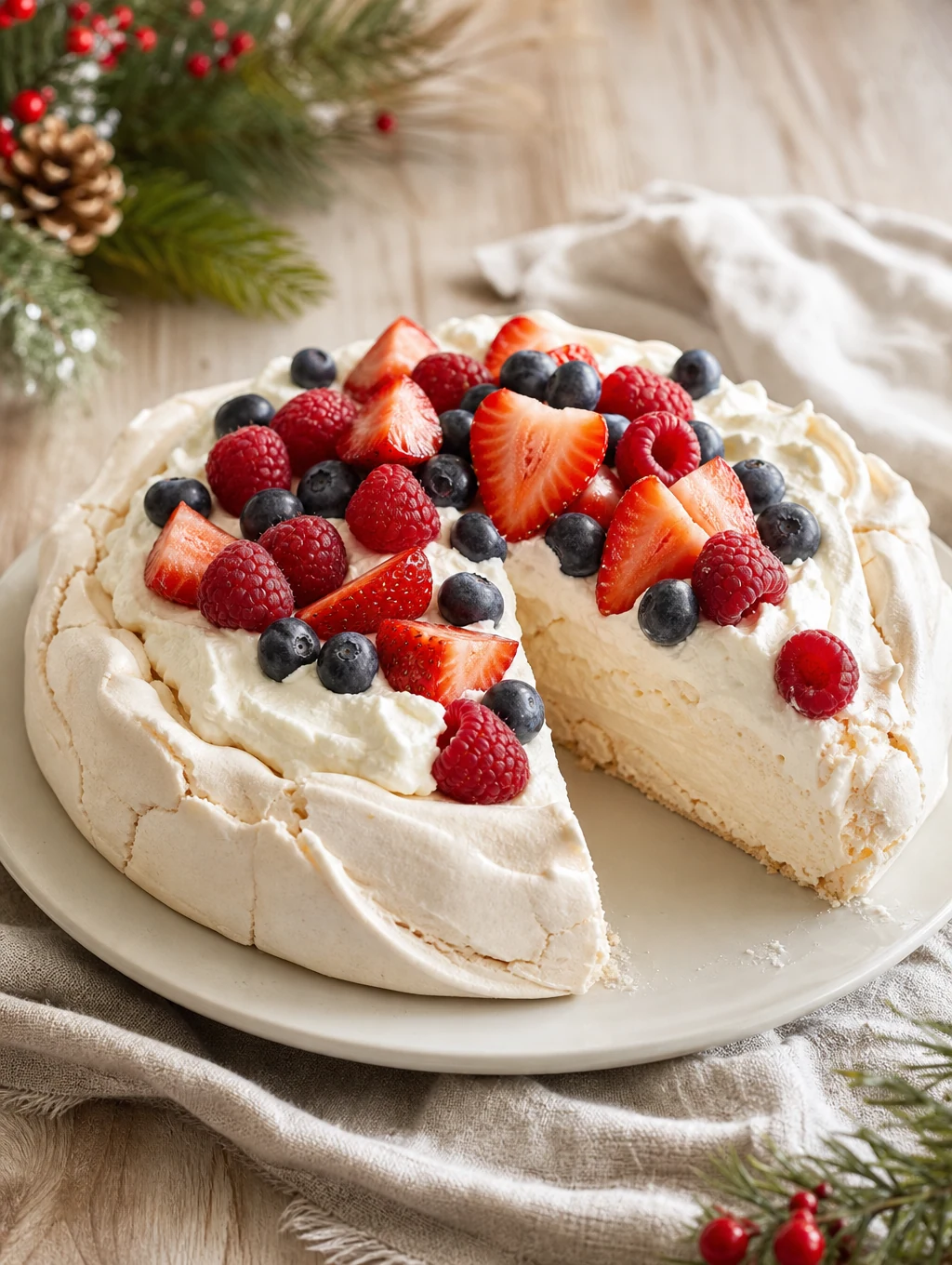
Christmas berry pavlova brings a crisp white meringue shell, a soft center, lightly sweetened cream and fresh berries to the holiday table. It is a dessert to finish near serving, not a cake to decorate the night before: the fruit and cream gradually soften the shell. This proposed 8–9-inch version uses pasteurized shell egg whites, a low oven and a long cool. Plan about 185 minutes and eight working slices, but both depend on a real meringue and serving test.
Jump to ingredients · Jump to method
A crisp edge and a soft middle
A pavlova is not intended to be dry all the way through like a small crunchy meringue cookie. Its outside should set into a pale shell, while the middle remains soft enough to receive cream. Whip the egg whites in a clean, grease-free bowl, add sugar slowly and check that the mixture looks glossy with little graininess between your fingers. A shallow hollow in the center keeps the topping from sliding off.
For this untested formula, use pasteurized shell eggs and separate four whites without any yolk. Pasteurized whites can behave differently from ordinary shell eggs, so the whip, bake and final texture are explicit kitchen-test questions. Do not casually replace them with an arbitrary carton product and assume it reaches the same volume. The white vinegar and cornstarch are measured parts of the shell, not an invitation to pour acid into the topping.
Meringue, cream and berries
| Ingredient | Amount | Use |
|---|---|---|
| Pasteurized shell egg whites | 4 large whites | Room temperature, with no yolk in bowl. |
| Superfine granulated sugar | 1 cup | Add gradually to meringue. |
| Cornstarch | 2 tsp | Fold gently into meringue. |
| White vinegar | 1 tsp | Meringue only. |
| Vanilla extract for meringue | 1 tsp | Meringue only. |
| Cold pasteurized heavy whipping cream | 1 cup | Whip for the topping. |
| Powdered sugar | 1 tbsp | Sweeten the cream lightly. |
| Vanilla extract for cream | 1/2 tsp | Separate from shell vanilla. |
| Fresh strawberries, hulled and quartered | 1 1/2 cups | Dry after washing. |
| Fresh raspberries | 1/2 cup | Handle gently. |
| Fresh blueberries | 1/2 cup | Dry before topping. |
You will need a mixer, two clean bowls, parchment-lined baking sheet and an offset spatula. Mark an 8–9-inch circle on the underside of the parchment as a shaping guide; no ink should touch the meringue. The strawberries, raspberries and blueberries total two and a half cups of measured fruit. A different berry mix may release a different amount of juice and change the shell after assembly.
Bake the shell; top it later
- Prepare the meringue. Heat oven to 250°F (120°C) and line a sheet with parchment. In a clean bowl, whip four room-temperature pasteurized shell egg whites to soft peaks. Add one cup superfine sugar a spoonful at a time, beating to glossy, firm peaks. The sugar should feel mostly dissolved. Gently fold in two teaspoons cornstarch, one teaspoon white vinegar and one teaspoon vanilla.
- Shape. Spoon the meringue inside the marked 8–9-inch circle and build the sides slightly higher than a shallow central well. Do not spread it into a thin disk: the outside and middle would dry at different rates. Smooth only enough to make a stable rim.
- Bake and cool. Bake an estimated seventy-five to ninety minutes, until the outside looks dry and carefully loosens from parchment while remaining pale. Turn off the oven and prop the door slightly; cool the shell inside for at least sixty minutes, then let it reach room temperature before cream. The cooling may take longer than the minimum. Do not force a warm shell onto a cold cream filling.
- Prepare topping near service. Wash and dry the berries according to FoodSafety.gov’s produce and chill guidance. Whip one cup cold pasteurized heavy cream with one tablespoon powdered sugar and half teaspoon vanilla to soft-to-medium peaks. Spread over the fully cooled shell. Add one and a half cups quartered strawberries, half cup raspberries and half cup blueberries.
- Serve. Cut into eight working slices and serve promptly. Cream and berries will soften the meringue with time. Refrigerate assembled leftovers promptly, but no overnight assembled-pavlova quality claim has been tested.
The conservative working total is thirty-five minutes hands-on shell and topping preparation, up to ninety minutes in the oven and at least sixty minutes cooling: 185 minutes. A humid kitchen, different egg product or oven can change the shell’s finish. Cooling to room temperature may extend the clock; make the shell early, then whip cream and add fruit close to dessert time.
When the shell misbehaves
Flat meringue: check for yolk or grease in the bowl, then confirm the whites whip before adding sugar. Grainy or weeping shell: superfine sugar should be added gradually, not all at once; record the egg and sugar product in a test. Brown exterior: check oven temperature and move the sheet away from a hot element; the target is pale. Cracks: some are normal in a delicate meringue, but a collapsed center or sticky pool needs review before photography.
Frozen berries thaw into extra liquid and are not a one-for-one topping. Sweetened whipped topping changes ingredient labels and texture. Replacing egg whites with aquafaba creates a different recipe, not a validated vegan variation. The base has egg and milk, and the meringue’s pasteurized shell eggs should be chosen and labelled accurately.
A light finish to a rich dinner
Move the unfilled shell gently to its serving plate before adding cream. It may crack if lifted after topping. Chefly’s published Black Forest Trifle is a different layered, chocolate-forward holiday dessert if you need a second table option, not a substitute for the berry topping here. The contrast is useful: one crisp-edged meringue and one spooned trifle.
Do not plan on an assembled pavlova holding perfectly through a long buffet. Wash and dry fruit just before topping and refrigerate cream until needed; if service is delayed, keep components separate. Specific shell shelf-life, cream holding and post-assembly texture require kitchen testing, so they are not promised as fixed durations in this draft.
Questions before you whip
Can I use carton egg whites?
Some pasteurized carton products are formulated for whipping and others are not. The working formula specifies whites from pasteurized shell eggs; a carton substitution needs its own volume and structure test.
Is a soft center underbaked?
A pavlova is meant to have a softer center, but the shell still needs a proper low-and-slow bake and an actual test with the specified egg product. Do not serve a visibly liquid raw-egg center or treat appearance alone as a verified safety measurement.
Can I assemble it the day before?
The cream and berry juice will soften the shell. Make the shell separately if you are planning ahead, then top near service; the exact component storage and assembled hold have not been validated.
Recipe-card handoff: One 8–9-inch berry pavlova, eight working slices; thirty-five minutes hands-on, up to ninety minutes baking and at least sixty minutes cooling, 185 minutes estimated. Eleven ingredients and five method steps above are proposed native fields. Nutrition, images, Tasty Recipes record and kitchen-test evidence are pending.
Print
Christmas Berry Pavlova
- Total Time: 185 minutes
- Yield: 8 servings 1x
Description
An 8–9-inch baked meringue shell with a soft center, topped with lightly sweetened whipped cream and three kinds of berries.
Ingredients
- 4 egg whites Large pasteurized shell egg whites, at room temperature
- 1 cup Superfine granulated sugar for meringue
- 2 teaspoons Cornstarch
- 1 teaspoon White vinegar
- 1 teaspoon Vanilla extract for meringue
- 1 cup Cold pasteurized heavy whipping cream
- 1 tablespoon Powdered sugar for cream
- 1/2 teaspoon Vanilla extract for cream
- 1 1/2 cups Fresh strawberries, hulled and quartered
- 1/2 cup Fresh raspberries
- 1/2 cup Fresh blueberries
Instructions
- Heat oven to 250 F (120 C). Line a sheet with parchment and mark an 8–9-inch circle on the underside. Separate 4 pasteurized shell eggs without any yolk in the clean bowl. Whip whites to soft peaks.
- Add 1 cup superfine sugar a spoonful at a time, beating to glossy stiff peaks and checking that grit is mostly dissolved. Gently fold in 2 teaspoons cornstarch, 1 teaspoon white vinegar and 1 teaspoon vanilla. Spread inside the circle with a shallow center well.
- Bake about 75–90 minutes until outside looks dry and releases carefully from parchment, without deeply browning. Turn oven off, prop door slightly and cool shell inside at least 60 minutes, then completely to room temperature before cream. Actual oven and pasteurized-egg performance require kitchen testing.
- Near serving, wash berries and dry them well. Whip 1 cup cold pasteurized heavy cream with 1 tablespoon powdered sugar and 1/2 teaspoon vanilla to soft-to-medium peaks. Spread over cooled shell, then distribute 1 1/2 cups quartered strawberries, 1/2 cup raspberries and 1/2 cup blueberries.
- Cut into 8 working portions and serve promptly. Refrigerate assembled leftovers promptly; crispness and storage quality are untested, so do not promise that an assembled pavlova holds overnight.
Notes
Recipe-development draft; not kitchen-tested. Timing and yield are estimates. Nutrition has not been calculated.
Additional chilling, resting or cooling time: 60 minutes, included in the total.
Working estimate: 25 minutes shell prep plus 10 minutes topping at service, up to 90 minutes low oven, at least 60 minutes oven cooling; full room-temperature cooling may take longer.
- Prep Time: 35 minutes
- Chilling, resting or cooling: 60 minutes
- Cook Time: 90 minutes
Nutrition
- Serving Size: One of eight working slices of an 8–9-inch pavlova; actual shell and fruit weights pending