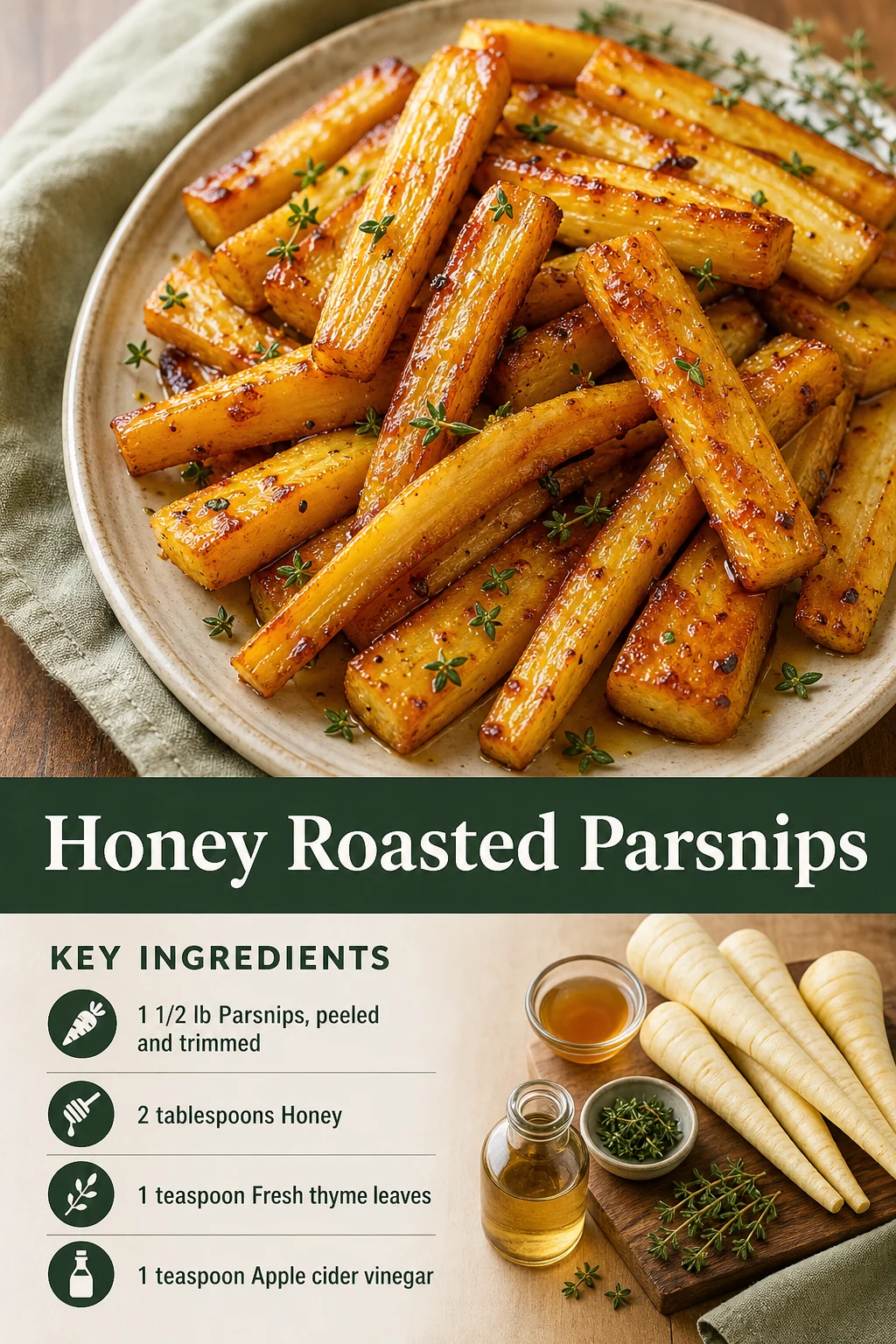
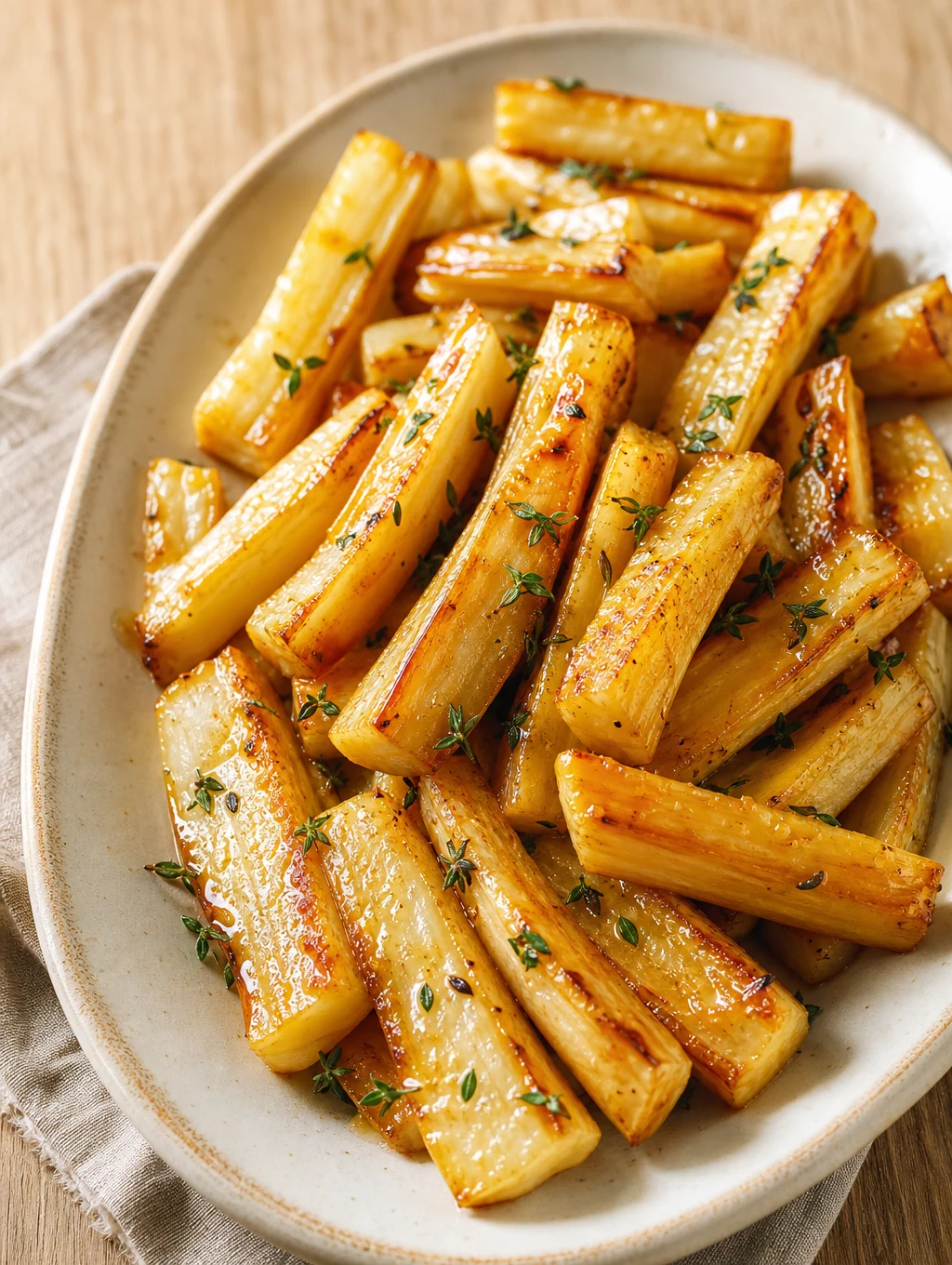
Honey roasted parsnips are a warm, lightly sticky side with browned edges and soft centers. In this working version, even parsnip batons roast in olive oil first, then get a small honey-and-cider-vinegar glaze near the end. That order matters: honey added at the beginning of a hot 425°F roast may darken before thicker roots become tender. Fresh thyme goes on after the oven. The forty-five-minute estimate and how quickly the glaze colors need a real kitchen trial.
Jump to ingredients · Jump to method
Cut the roots evenly before thinking about glaze
Parsnips taper from a broad shoulder to a narrow end. If every piece is cut to the same length only, a thin tip may burn while a thick top remains firm. Halve or quarter the upper portions lengthwise so the batons are closer in width. Younger, smaller parsnips can have a more tender core than very large ones; if a test specimen has a woody center, trim it rather than expecting honey to soften it.
The Kitchn’s roasted-parsnip guide shows the importance of even batons and a 425°F sheet-pan method, but it finishes with dukkah spices. This Chefly proposal instead uses a measured late honey-cider coating and fresh thyme. The site’s existing honey-glazed baby carrots share a sweet side-dish role, but carrot and parsnip are different vegetables with different preparation and flavor.
Ingredients for four sides
| Ingredient | Amount | Use |
|---|---|---|
| Parsnips, peeled and trimmed | 1½ lb | Cut into roughly even-width batons. |
| Olive oil | 1½ tbsp | Coats vegetables for the first roast. |
| Fine salt | ½ tsp | Seasoning before roasting. |
| Black pepper | ¼ tsp | Balances the sweet finish. |
| Honey | 2 tbsp | Late glaze, not an early roast coating. |
| Apple cider vinegar | 1 tsp | Small amount of acid with honey. |
| Fresh thyme leaves | 1 tsp | Scatter after roasting. |
Measure the parsnips after peeling and trimming if possible. The one-and-a-half-pound starting amount may yield less usable vegetable when shoulders or tough cores are removed. Honey is in the actual formula, so this is not a vegan side. Maple syrup would be a different variation with a potentially different coating and sweetness; it should not be quietly substituted while retaining the honey title and photograph.
Two-stage sheet-pan roast
- Preheat and cut. Heat oven to 425°F. Peel and trim one and a half pounds parsnips. Cut thick tops lengthwise into halves or quarters and leave narrow pieces larger so the final batons are similar width. Use a large rimmed sheet.
- Begin roasting. Toss the parsnips with one and a half tablespoons olive oil, one-half teaspoon fine salt and one-quarter teaspoon black pepper. Spread in one layer and roast approximately twenty minutes, turning once, until some edges begin to brown and thick pieces start to soften.
- Add measured glaze. Stir two tablespoons honey with one teaspoon apple cider vinegar. Drizzle over the hot parsnips and toss carefully. Return the sheet to the oven for approximately eight to ten more minutes, checking toward the end for tender centers and a light sticky sheen rather than burned syrup.
- Finish. Scatter one teaspoon fresh thyme leaves over the hot parsnips, transfer to a platter and divide into four side portions. Record the actual cut size and roast time in a kitchen trial.
The proposed time is fifteen minutes preparation and up to thirty minutes roasting, excluding oven preheat. The honey is applied only for the final part of the roast. A different pan material, oven or cut thickness can change how fast both parsnip edges and honey brown, so a timer alone should not determine when to serve.
What to watch on the baking sheet
The tips char. Cut them less thin or pull smaller pieces toward the center of the pan when turning. A completely crowded tray steams, but very thin pieces on a bare hot corner can burn quickly. Record the cut geometry for a repeatable recipe.
The glaze turns dark. Add honey only after the initial twenty-minute roast. If browning accelerates during the final interval, remove the pan as soon as the vegetable is tender and the glaze lightly sticky. Do not wait for all pieces to look like dark caramel.
The center stays woody. Check the starting roots. A very large parsnip may need its tough core removed, and thick shoulders need more even cutting. Extend roasting without honey first if necessary, then apply the glaze near the actual finish in a revised method.
The dish tastes too sweet. This first formula uses two tablespoons honey and one teaspoon cider vinegar for one and a half pounds parsnips. Parsnips themselves vary in sweetness. Taste a test batch and adjust measured proportions next time rather than adding arbitrary acid to a finished platter.
Serving and variations
Serve alongside a roast dinner or a savory winter main where a sweet root vegetable makes sense. For two different sides on a holiday table, Chefly’s honey-glazed baby carrots offer a brighter orange color but repeat a honey note; a green vegetable might provide more contrast. The hero photo should show pale golden parsnip batons, not carrots mixed in or a maple glaze that is absent from the card.
Fresh rosemary instead of thyme would make a woodier herb finish, and adding mustard would change the glaze. Either needs a measured variation. This draft contains no butter or nuts, but no diet label has been formally checked. If honey is replaced with maple, the title should also change to avoid misleading readers.
Make-ahead and leftovers
Cut the parsnips shortly before roasting, or keep prepared pieces appropriately chilled and dry so the first roast browns rather than steams. A staged roast might be useful for a crowded holiday oven, but it requires a trial to establish how reheating affects texture and glaze. Cool leftovers and refrigerate promptly in a covered container. Their exact storage duration and the best reheating method have not been checked for this honey-coated version; do not promise a freezer-friendly crisp finish.
Questions before roasting
Do the parsnips need peeling?
This working recipe specifies peeled and trimmed roots for consistent texture. A very young parsnip may have tender skin, but leaving it on would be a separately assessed variation.
Can I put honey on from the start?
Not in this two-stage method. The parsnips get about twenty minutes to soften and brown before the measured honey-cider glaze is added for the final eight to ten minutes.
Can I add carrots?
Yes as a different root-vegetable mixture, but carrot proportions, cuts, roast time and title would change. The measured base is parsnips only; Chefly already has a separate baby-carrot side.
Recipe-card handoff — preview, not a native plugin card
Honey Roasted Parsnips. Four side portions. Prep approximately 15 minutes; roast approximately 30 minutes; total approximately 45 minutes after oven preheat. Sheet-pan method. Not kitchen-tested; nutrition not calculated.
Ingredients: 1½ lb peeled trimmed parsnips; 1½ tbsp olive oil; ½ tsp fine salt; ¼ tsp black pepper; 2 tbsp honey; 1 tsp apple cider vinegar; 1 tsp fresh thyme leaves.
Instructions: Heat oven to 425°F. Cut parsnips into even-width batons, toss with olive oil, salt and pepper and spread on a rimmed sheet. Roast about twenty minutes, turning once. Mix honey and cider vinegar, toss with parsnips and roast another eight to ten minutes until tender and lightly sticky. Finish with thyme. Test size, glaze and timing before publication.
Print
Honey Roasted Parsnips
- Total Time: 45 minutes
- Yield: 4 servings 1x
Description
Four sides of parsnip batons roasted until golden and glazed late with honey and cider vinegar.
Ingredients
- 1 1/2 lb Parsnips, peeled and trimmed
- 1 1/2 tablespoons Olive oil
- 1/2 teaspoon Fine salt
- 1/4 teaspoon Black pepper
- 2 tablespoons Honey
- 1 teaspoon Apple cider vinegar
- 1 teaspoon Fresh thyme leaves
Instructions
- Heat the oven to 425°F. Peel and trim 1 1/2 lb parsnips; halve thick tops lengthwise so all batons are similar width. Toss with 1 1/2 tbsp olive oil, 1/2 tsp salt and 1/4 tsp black pepper on a large rimmed sheet. Spread in one layer.
- Roast about 20 minutes, turning once, until edges begin to brown and the thicker pieces start to soften.
- Stir 2 tbsp honey with 1 tsp apple cider vinegar. Drizzle over the parsnips and toss carefully to coat; return the pan to the oven about 8–10 minutes, watching the glaze, until batons are fork-tender and lightly sticky rather than burned.
- Scatter 1 tsp fresh thyme leaves over the hot parsnips, turn onto a platter and divide into four side portions. Test actual glaze and parsnip thickness in a kitchen trial.
Notes
Recipe-development draft; not kitchen-tested. Timing and yield are estimates. Nutrition has not been calculated.
Untested estimate at 425°F, 20-minute first roast and 8–10-minute honey finish; oven preheat excluded.
- Prep Time: 15 minutes
- Cook Time: 30 minutes
Nutrition
- Serving Size: One quarter of the finished pan