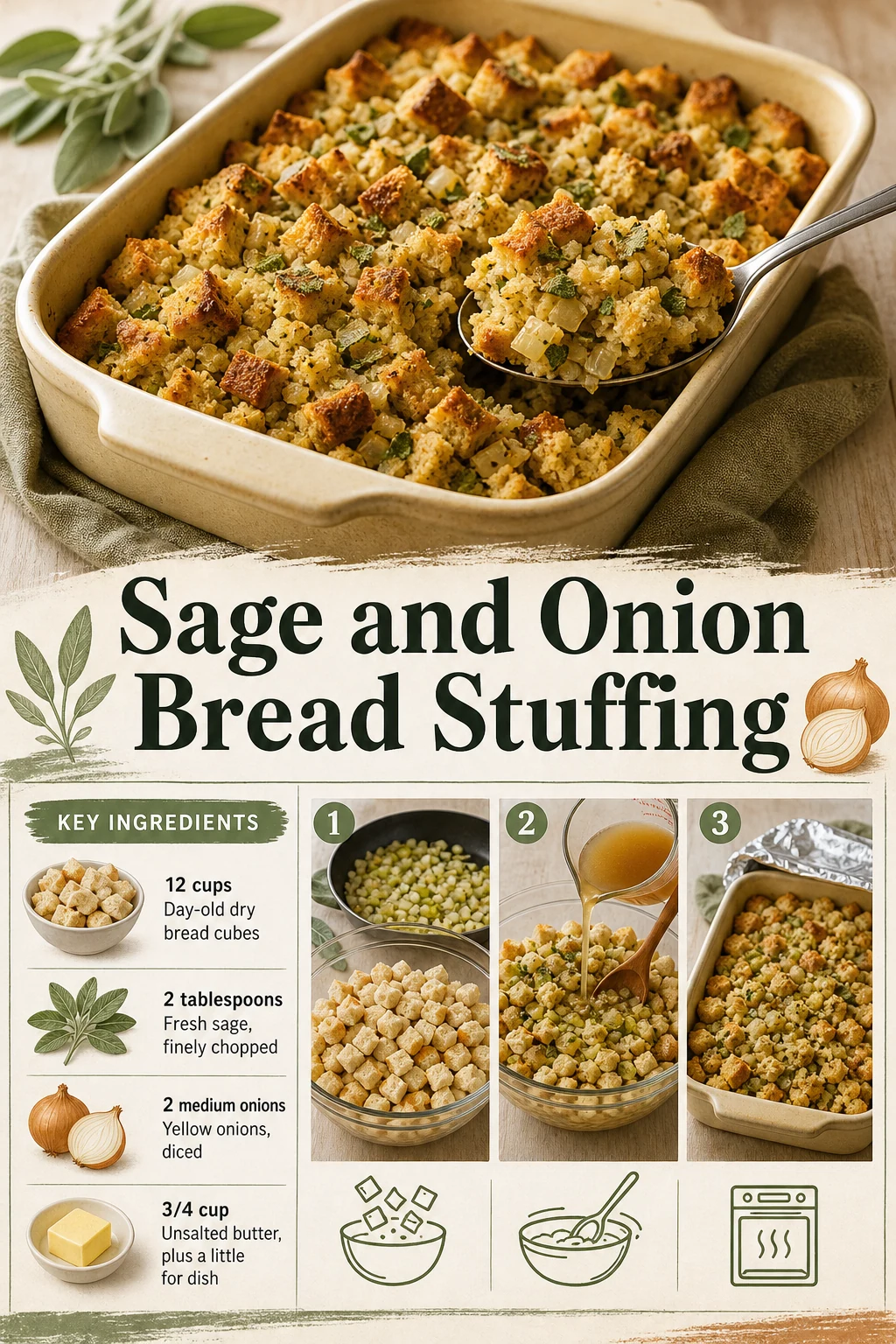
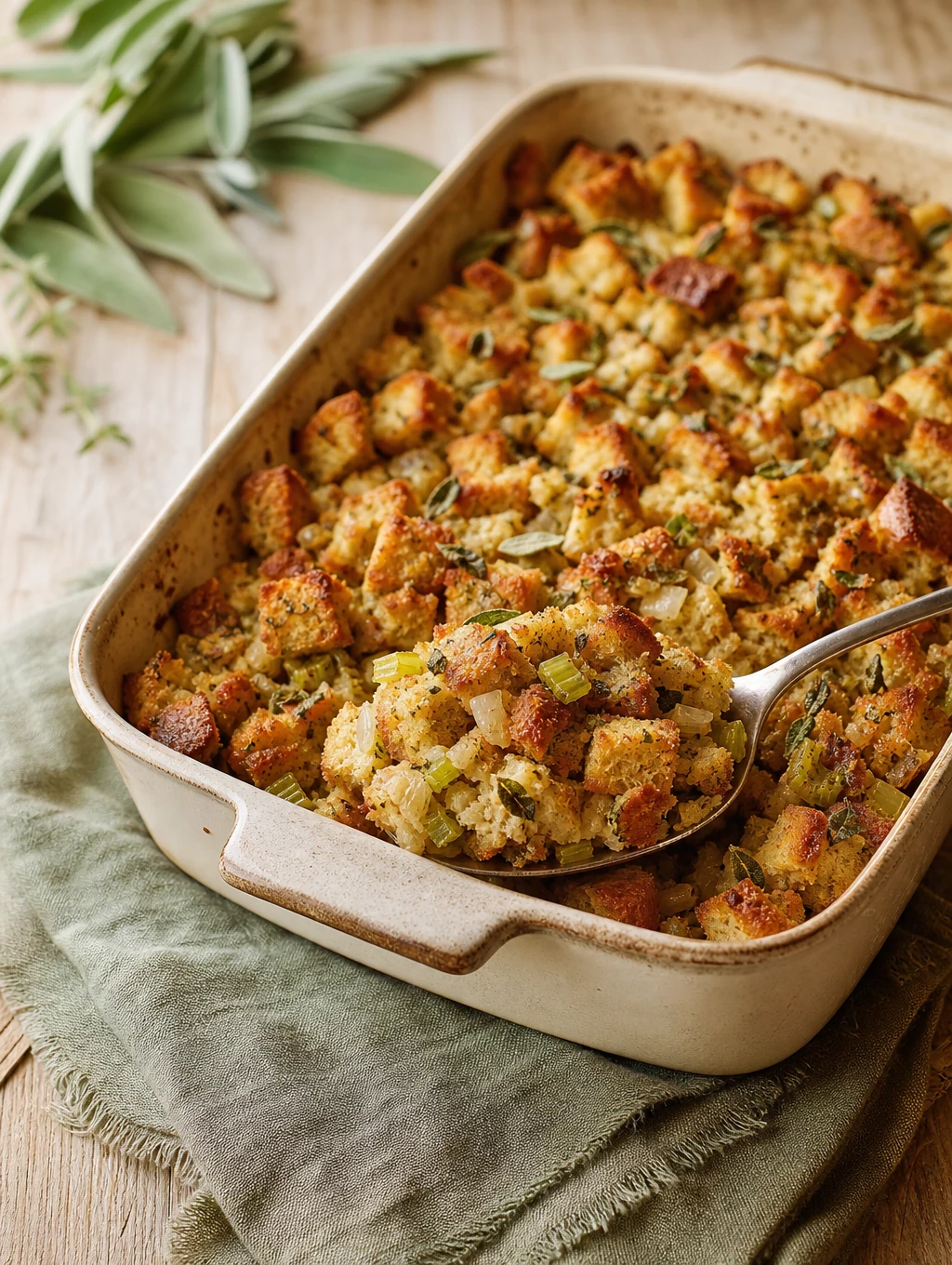
Sage and onion bread stuffing is the pan of browned, herby bread that belongs beside a holiday roast. This proposed version is baked in a dish rather than inside poultry, giving the top room to turn golden while the middle stays moist. It starts with twelve cups of already-dry bread cubes, softened onions and celery, fresh herbs, broth and beaten eggs. That bread assumption matters: drying fresh soft bread takes additional time. Twelve portions and a 90-minute planning total still need a kitchen test.
Jump to ingredients · Jump to method
Dry bread is part of the formula
Soft fresh bread collapses as it drinks broth. Day-old cubes that feel dry on their cut faces keep more distinct edges after baking. Measure the twelve cups after cubing and drying, not before slicing a loaf. Different breads have different densities and absorbency, so the amount of broth is a starting point to test, not a universal promise of exactly the same texture for sourdough and sandwich bread.
Butter carries the softened onion and celery into the bread. Fresh sage is the main herb; a smaller amount of thyme rounds it out. Use low-sodium broth because salt levels vary widely, then taste the cooked dish before seasoning further. The egg binds the pan, which is why the center should be checked rather than judging doneness from the golden top alone.
Ingredients for a 9-by-13-inch dish
| Ingredient | Amount | Preparation |
|---|---|---|
| Day-old dry bread cubes | 12 cups | Measure already cubed and dry. |
| Unsalted butter | 3/4 cup, plus a little for dish | Cook vegetables; grease pan lightly. |
| Yellow onions | 2 medium | Dice. |
| Celery | 3 stalks | Dice. |
| Fresh sage | 2 tbsp chopped | Finely chop. |
| Fresh thyme leaves | 1 tbsp | Strip from stems. |
| Low-sodium chicken or vegetable broth | 2 cups | Use one chosen brand for testing. |
| Large eggs | 2 | Beat before folding into bread. |
| Fine salt | 1/2 tsp | Start measured; broth may vary. |
| Black pepper | 1/2 tsp | Freshly ground. |
Use a large skillet and mixing bowl, a lightly buttered 9-by-13-inch baking dish, foil and a food thermometer. The butter for greasing is a thin coating from the kitchen, not an extra half cup; measure it in a final test if nutrition is eventually calculated. Broth choice changes whether the finished dish is vegetarian, and even vegetable broth alone does not make a butter-and-egg stuffing vegan.
Sauté, moisten and bake
- Set up. Heat the oven to 350°F (175°C) and lightly butter a 9-by-13-inch dish. Put twelve measured cups of dry day-old bread cubes in a large bowl. If your bread is still fresh and soft, dry the cubes separately first and add that step to the actual preparation time.
- Soften the vegetables. Melt three-quarter cup unsalted butter in a skillet over medium heat. Add two diced onions and three diced celery stalks; cook about eight to ten minutes until softened, not deeply browned. Stir in two tablespoons chopped sage and one tablespoon fresh thyme for the final minute.
- Moisten evenly. Pour the vegetables and butter over the bread. Toss with two cups low-sodium broth, half teaspoon salt and half teaspoon pepper. Fold in two beaten eggs so no single corner receives all the binder. The cubes should be moist but not floating in liquid. Do not taste the raw-egg mixture.
- Bake the center through. Spread in the prepared dish, cover with foil and bake about thirty minutes. Remove foil and bake approximately fifteen minutes more, until top is lightly golden and center reaches 165°F as an egg-containing casserole under FoodSafety.gov’s casserole chart. Re-cover if the surface browns before the center is ready.
- Rest and serve. Let stand about ten minutes before dividing into twelve working portions. Refrigerate leftovers promptly in shallow containers and reheat thoroughly to 165°F. This recipe is for a baking dish; do not put this untested mixture inside a turkey cavity.
Allow about twenty-five minutes preparation, ten minutes on the stove, forty-five minutes in the oven and ten minutes resting, totaling 90 minutes. The active sauté is included in the 55-minute cook estimate. Bread-drying time is outside this clock because the ingredient is already dry; if a future article promises “from a fresh loaf,” it must include that separate step. A deeper dish or larger batch could extend center heating.
Adjust texture without hiding the change
Dry patches: toss more evenly before deciding to add liquid. Record extra broth in the test; a silent increase would make the published ingredient list wrong. Wet or dense center: check whether bread started soft, whether it was compressed into the pan and whether the thermometer reached the center. Dark top, cool center: cover again and continue baking. Strong sage: fresh and dried herbs are not volume-for-volume substitutes; this formula uses fresh chopped leaves.
For a meatless dinner, choose a vegetable broth with a checked label. Sausage would create a different stuffing with different fat, cooking and allergens. Gluten-free bread changes absorption and crumb behavior, while nondairy butter and egg substitutes change structure; none is validated here. The base contains wheat, milk and egg when made with ordinary bread and butter.
On the holiday table
Chefly’s published honey-glazed baby carrots are a separate bright vegetable side for the same meal. The stuffing’s butter-and-sage flavor works best when other dishes do not all repeat the same herb. Use a serving spoon that reaches the golden top and moist inner cubes in one scoop, then cover leftovers rather than letting the pan sit out for a long buffet.
For make-ahead planning, drying and cubing the bread in advance is different from storing the fully moistened egg mixture overnight. The latter has not been tested for texture or timing in this draft. Keep perishable ingredients cold, finish the assembly close to baking for the first trial and measure the actual center temperature. A specific frozen-stuffing quality claim awaits a reheating test.
Common questions
Is this dressing or stuffing?
It is a seasoned bread mixture baked separately in a dish. Some cooks call that dressing; the title uses “stuffing” because readers search for the flavor and side-dish format. It is not a bird-cavity method.
Can I use dried sage?
Not at the same two-tablespoon volume without a separate flavor test. The working recipe uses fresh sage, which is usually less concentrated by volume.
Can I make it with very fresh bread?
Dry the cubes first so they hold distinct edges. Record the drying temperature and minutes in a new test; the present 90-minute planning total assumes cubes are already dry.
Recipe-card handoff: One 9-by-13-inch pan, twelve working portions; twenty-five minutes prep, about fifty-five minutes combined stovetop and oven cook, ten minutes rest, 90 minutes total estimated with pre-dried bread. Ten ingredients and five steps above are proposed native-card fields. Nutrition, images, Tasty Recipes record and kitchen-test evidence are pending.
Print
Sage and Onion Bread Stuffing
- Total Time: 90 minutes
- Yield: 12 servings 1x
Description
Dry bread cubes moistened with onion, celery, sage, broth and egg, baked in a 9-by-13-inch dish outside the bird.
Ingredients
- 12 cups Day-old dry bread cubes
- 3/4 cup Unsalted butter, plus a little for dish
- 2 medium onions Yellow onions, diced
- 3 stalks Celery stalks, diced
- 2 tablespoons Fresh sage, finely chopped
- 1 tablespoon Fresh thyme leaves
- 2 cups Low-sodium chicken or vegetable broth
- 2 eggs Large eggs, beaten
- 1/2 teaspoon Fine salt
- 1/2 teaspoon Freshly ground black pepper
Instructions
- Heat oven to 350 F (175 C) and lightly butter a 9-by-13-inch baking dish. Put 12 cups dry day-old bread cubes in a large bowl. If bread is fresh and soft, dry it separately first and add that time to the schedule.
- Melt 3/4 cup unsalted butter in a skillet over medium heat. Cook 2 diced medium onions and 3 diced celery stalks about 8–10 minutes until softened. Stir in 2 tablespoons chopped fresh sage and 1 tablespoon fresh thyme for the final minute.
- Pour cooked vegetables and butter over bread. Toss with 2 cups low-sodium broth, 1/2 teaspoon salt and 1/2 teaspoon pepper. Fold in 2 beaten eggs until evenly distributed; the cubes should be moist but not swimming. Do not taste the raw-egg mixture.
- Transfer to the buttered dish, cover with foil and bake about 30 minutes. Uncover and bake another 15 minutes or until top is lightly golden and the center reaches 165 F (74 C) as an egg-containing casserole. If top darkens early, re-cover and continue checking the center.
- Rest 10 minutes before dividing into 12 working portions. Refrigerate leftovers promptly in shallow containers and reheat to 165 F (74 C). This dish is baked separately; do not put the proposed mixture inside poultry.
Notes
Recipe-development draft; not kitchen-tested. Timing and yield are estimates. Nutrition has not been calculated.
Additional chilling, resting or cooling time: 10 minutes, included in the total.
Working estimate assumes 12 cups already dry bread cubes: 25 minutes prep, about 10 minutes stovetop and 45 minutes oven, 10 minutes rest. Drying fresh bread takes additional time.
- Prep Time: 25 minutes
- Chilling, resting or cooling: 10 minutes
- Cook Time: 55 minutes
Nutrition
- Serving Size: One twelfth of a 9-by-13-inch pan; actual mass and bread volume variation pending