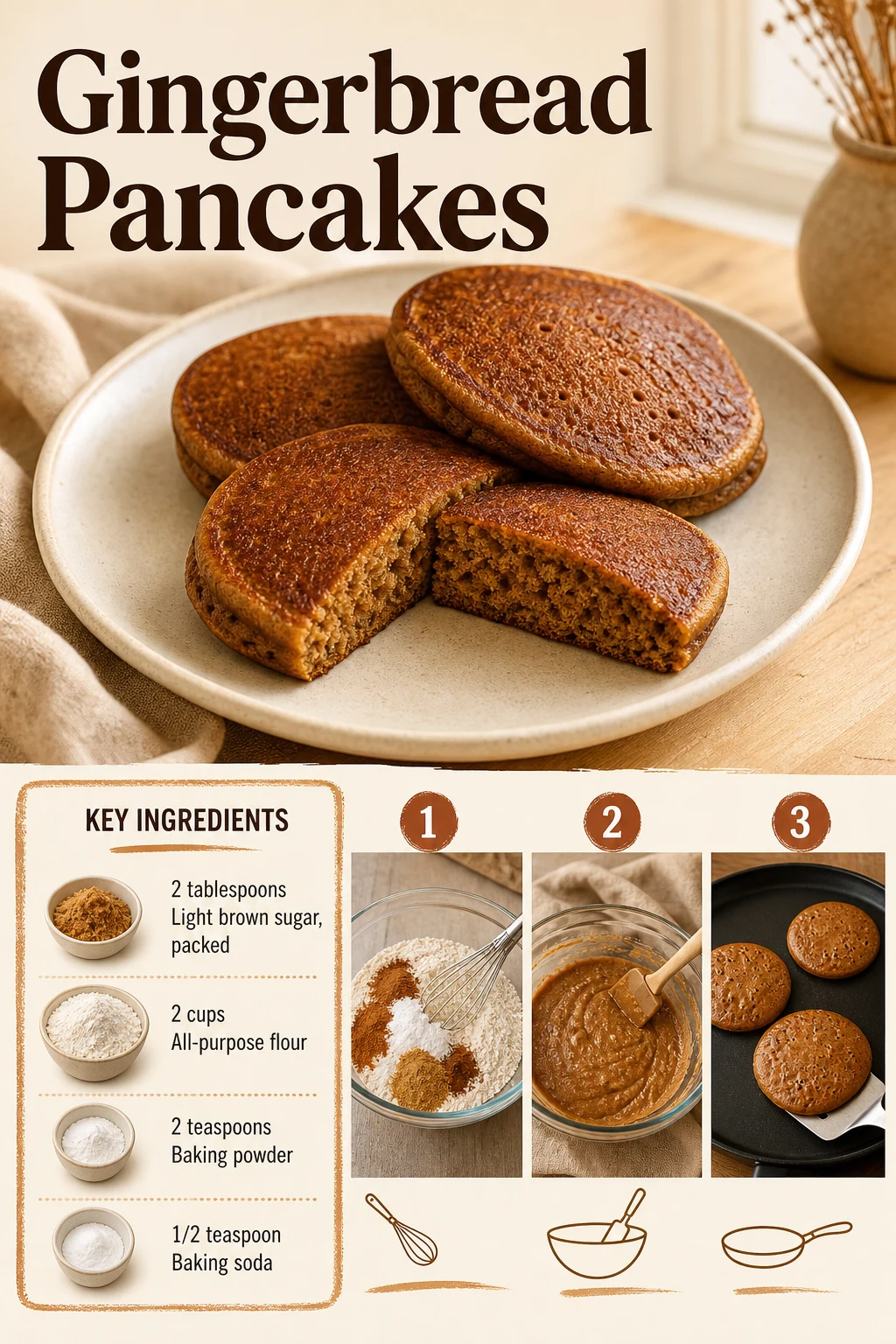
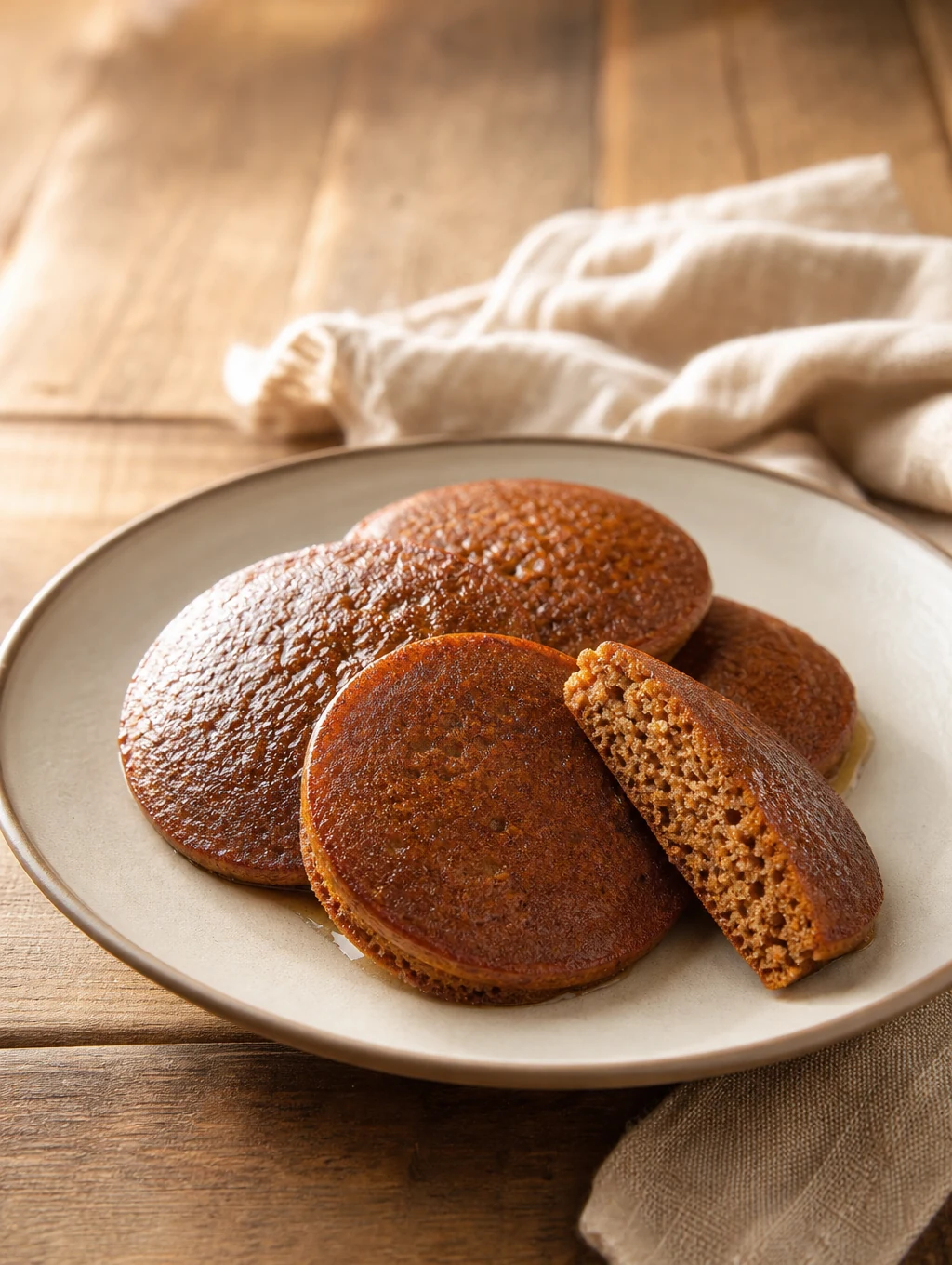
Gingerbread pancakes bring the warm spice of a holiday cookie to a weekend breakfast without asking you to roll or chill dough. This proposed buttermilk batter uses molasses for dark flavor, ground ginger and cinnamon for warmth, and a little clove in the background. Cook small rounds on a moderately heated griddle so the centers finish before the exteriors get too dark. The formula is designed for about twelve 4-inch pancakes, six working servings of two; test the actual yield and 40-minute planning time before publishing it.
Jump to ingredients · Jump to method
Why molasses needs moderate heat
Molasses contributes the recognizable gingerbread color and flavor, but a sugary batter can brown quickly. A medium griddle gives the leavening time to lift the pancake while its middle sets. If the first round turns very dark before bubbles appear and the edge looks dry, lower the heat and let the pan settle before pouring the next batch. These are pancakes, not griddle cookies; the batter should be spoonable but not so thick it sits in a tall mound.
Buttermilk supplies acidity for the baking soda, while baking powder adds lift on its own. Whisk dry and wet components separately, then stop mixing when no large dry flour pockets remain. Some small lumps are normal. Overbeating develops a tougher texture, and raw batter is not for tasting: FDA’s flour guidance explains why uncooked flour can carry germs.
Ingredients for twelve working pancakes
| Ingredient | Amount | Use |
|---|---|---|
| All-purpose flour | 2 cups | Spoon and level for a consistent test. |
| Baking powder | 2 tsp | Fresh leavening. |
| Baking soda | 1/2 tsp | Works with buttermilk. |
| Ground ginger | 2 tsp | Main spice. |
| Ground cinnamon | 1 tsp | Warm aroma. |
| Ground cloves | 1/4 tsp | Use lightly; do not replace with a full teaspoon. |
| Fine salt | 1/2 tsp | Balances the sweetness. |
| Large eggs | 2 | Whisk into the wet mixture. |
| Buttermilk | 1 3/4 cups | Keep a little extra for a tested adjustment if needed. |
| Unsulfured molasses | 1/4 cup | Measured gingerbread flavor. |
| Light brown sugar, packed | 2 tbsp | Modest added sweetness. |
| Unsalted butter, melted and slightly cooled | 3 tbsp | Mixed into batter, not a topping. |
| Neutral oil for griddle | 2 tsp | Use sparingly across batches. |
Use two mixing bowls, a whisk, measuring cups, a large nonstick skillet or griddle, a quarter-cup measure and a wide spatula. Maple syrup or whipped cream would be optional serving items, not included in this base formula, photo or nutritional serving. Pan size and the number of rounds you can cook at once affect the real elapsed time.
Cook the batches
- Mix the dry ingredients. In a large bowl whisk two cups flour with two teaspoons baking powder, half teaspoon baking soda, two teaspoons ginger, one teaspoon cinnamon, quarter teaspoon cloves and half teaspoon salt. Break up any spice lumps so one pancake does not get all the clove.
- Mix the wet ingredients. In another bowl whisk two eggs, one and three-quarter cups buttermilk, quarter cup unsulfured molasses, two tablespoons packed brown sugar and three tablespoons melted, slightly cooled butter. Stir until the thick molasses has dispersed rather than settling at the bottom.
- Combine gently. Add the wet mixture to the dry and fold only until no broad streaks of flour remain. Small lumps are acceptable. If the measured batter is too thick to spread to roughly four inches from a quarter cup, note that in the test and add a little buttermilk only with the change recorded; the stated formula has not been pan-tested.
- Heat the griddle. Preheat to medium and lightly brush with part of the two teaspoons neutral oil. Pour about quarter-cup portions, allowing space to flip. Cook roughly two to three minutes, until bubbles appear and edges look set; flip and cook about one to two more minutes until the middle is fully set, not wet batter. Adjust the heat before a batch burns.
- Finish and serve. Repeat with the remaining oil and batter for approximately twelve pancakes. Keep cooked rounds warm briefly on a tray rather than stacking a tall, steamy pile. Divide into six working servings of two, and serve immediately with toppings chosen separately.
Fifteen minutes prep plus about twenty-five minutes across several griddle batches gives the 40-minute estimate. A large griddle may hold three or four pancakes, while a small skillet takes longer. Use the observable dry edge and set center, not only the clock or dark color, to determine when to flip and when to remove.
Substitutions and griddle fixes
Dark outside, gummy inside: lower the heat and make smaller quarter-cup rounds. Heavy pancakes: use active leaveners and avoid prolonged whisking after wet meets dry. Streaky spice: whisk it thoroughly into the flour before adding liquid. Too thick: record your flour-measuring method; a flour-weight test would help establish the most reliable hydration.
Blackstrap molasses is often more bitter than the ordinary unsulfured molasses intended here. A plain milk-and-lemon substitute for buttermilk may behave differently and needs a separate test. A gluten-free flour blend, nondairy milk or egg replacement changes texture and allergens, so none can be presented as a validated one-for-one version. Do not label the base dairy-free, egg-free or gluten-free.
Serving and leftovers
For a savory breakfast contrast, Chefly’s published Mushroom and Swiss Sheet Pan Omelette is a separate recipe. A small pancake stack beside an egg dish makes sense on a brunch table, but it does not alter this recipe’s serving size. Warm syrup can be offered at the table without quietly including it in the batter or image.
Cool leftovers promptly and refrigerate in a covered shallow container. FoodSafety.gov’s chill guidance recommends a refrigerator at 40°F or below and prompt refrigeration of perishable food. The exact texture after freezing and reheating, and a recipe-specific storage duration, need testing. Reheat only the portions needed and check that the centers are thoroughly hot before serving.
Three useful questions
Can the batter be made the night before?
Mixing leavened batter well ahead can change its rise. The proposed method mixes immediately before cooking; a refrigerated overnight version would need a separate texture and timing test.
Can I use a waffle iron?
A waffle iron needs a different fill level, release behavior and cooking time. This batter is only proposed as griddle pancakes, so a waffle promise would require testing.
How large is one serving?
Two of the roughly twelve quarter-cup-batter pancakes is one working serving. Their final diameter and weight are unmeasured, and syrup, butter and other toppings are separate.
Recipe-card handoff: About twelve 4-inch gingerbread pancakes, six working two-pancake servings; fifteen minutes preparation plus approximately twenty-five minutes griddle cooking, 40 minutes estimated. The thirteen listed ingredients and five steps above form the proposed native card. Numerical nutrition, a Tasty Recipes record and a kitchen test are not available.
Print
Gingerbread Pancakes
- Total Time: 40 minutes
- Yield: 6 servings 1x
Description
Small buttermilk pancakes flavored with unsulfured molasses, ginger, cinnamon and a little clove.
Ingredients
- 2 cups All-purpose flour
- 2 teaspoons Baking powder
- 1/2 teaspoon Baking soda
- 2 teaspoons Ground ginger
- 1 teaspoon Ground cinnamon
- 1/4 teaspoon Ground cloves
- 1/2 teaspoon Fine salt
- 2 eggs Large eggs
- 1 3/4 cups Buttermilk
- 1/4 cup Unsulfured molasses
- 2 tablespoons Light brown sugar, packed
- 3 tablespoons Unsalted butter, melted and slightly cooled
- 2 teaspoons Neutral oil for griddle
Instructions
- Whisk 2 cups flour, 2 teaspoons baking powder, 1/2 teaspoon baking soda, 2 teaspoons ginger, 1 teaspoon cinnamon, 1/4 teaspoon cloves and 1/2 teaspoon salt.
- Whisk 2 eggs, 1 3/4 cups buttermilk, 1/4 cup unsulfured molasses, 2 tablespoons packed brown sugar and 3 tablespoons melted slightly cooled butter in another bowl.
- Fold wet into dry just until broad flour streaks disappear; small lumps can remain. Do not taste raw batter.
- Heat a griddle to medium and brush lightly with part of 2 teaspoons neutral oil. Pour 1/4-cup rounds. Cook about 2–3 minutes until bubbled with set-looking edges, flip and cook about 1–2 minutes until centers are fully set. Lower heat if darkening too fast.
- Repeat for about 12 working pancakes. Divide into 6 servings of two. Serve promptly; toppings are separate.
Notes
Recipe-development draft; not kitchen-tested. Timing and yield are estimates. Nutrition has not been calculated.
Working estimate assumes several griddle batches; actual pan capacity and yield pending.
- Prep Time: 15 minutes
- Cook Time: 25 minutes
Nutrition
- Serving Size: Two of approximately twelve 4-inch pancakes; actual yield and weight not measured, toppings excluded