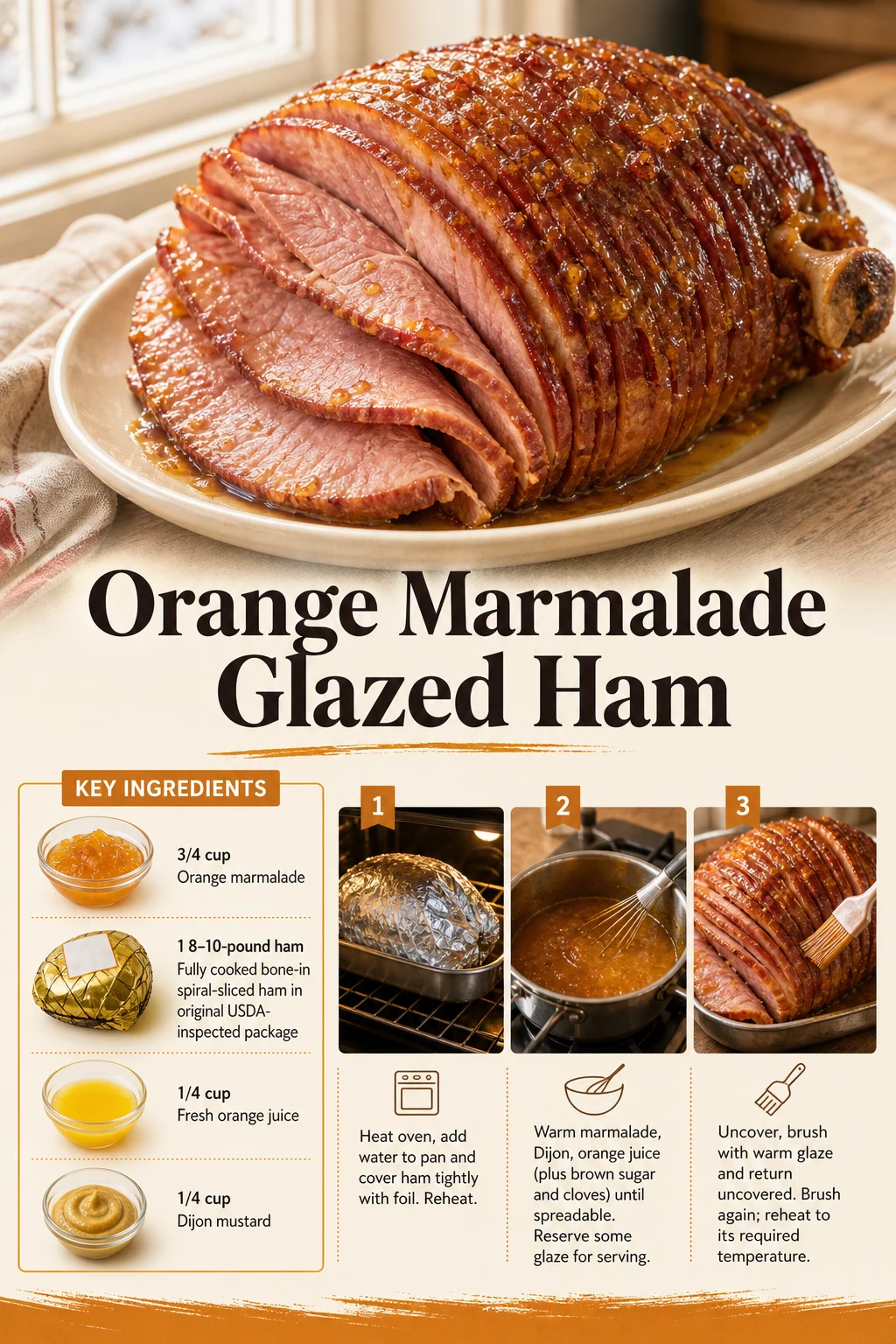
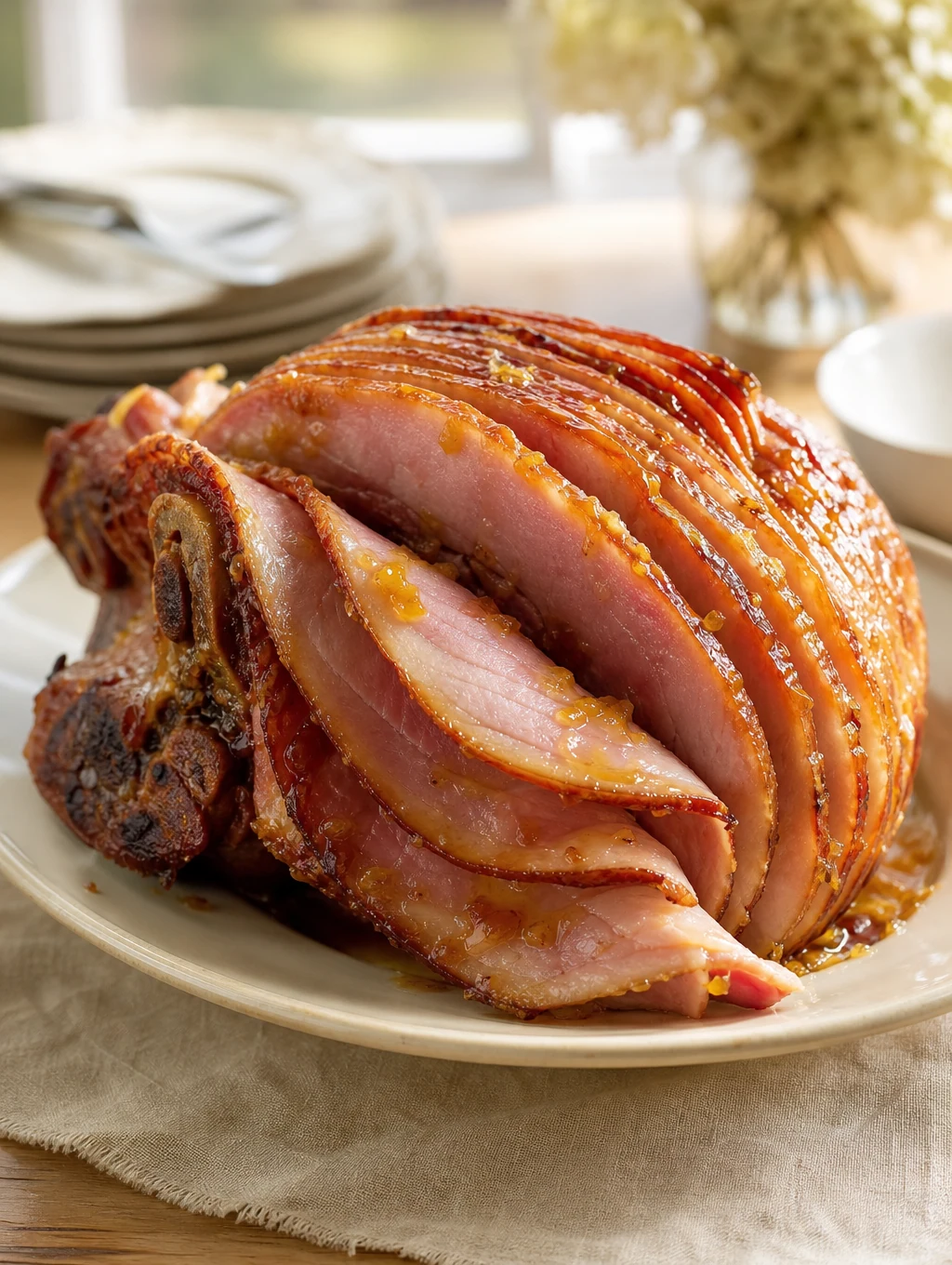
Orange marmalade glazed ham is a practical holiday centerpiece when the ham itself is already fully cooked. This working recipe starts with an originally packaged, USDA-inspected, bone-in spiral ham, warms it gently under foil, then brushes on a tart-sweet marmalade and Dijon glaze near the end. The orange should brighten the smoky-salty slices rather than become a thick candy shell. Plan for an 8–10-pound ham and twelve working portions, but let the package instructions and a thermometer set the actual reheating time.
Jump to ingredients · Jump to method
Choose the ham before timing the meal
This is not a method for a raw, cook-before-eating ham. The base calls for a fully cooked spiral-sliced ham still in the original USDA-inspected package. That distinction affects the reheating endpoint: FoodSafety.gov’s temperature chart says cooked hams packaged in USDA-inspected plants should reach 140°F on reheating, while other precooked hams for reheating reach 165°F. Leftover ham also reheats to 165°F. Check your actual label, follow any more specific package directions, and do not substitute a raw ham without an entirely different cooking plan.
Spiral slices are convenient at the table but dry out when exposed to oven air for too long. Keep the ham covered and cut-side down for most of the warming, then glaze late. The marmalade’s fruit pieces and sugar can darken quickly; a little Dijon, juice and a tiny measure of clove keep the finish balanced. You can reserve some untouched warm glaze for serving, but never put a brush that touched the ham into the table portion.
Ingredients for one holiday ham
| Ingredient | Amount | Purpose |
|---|---|---|
| Fully cooked bone-in spiral-sliced ham, original USDA-inspected package | One 8–10-lb ham | Read its label and reheating directions first. |
| Orange marmalade | 3/4 cup | Fruit and glaze body. |
| Dijon mustard | 1/4 cup | Tartness against sweet marmalade. |
| Fresh orange juice | 1/4 cup | Loosens the glaze. |
| Light brown sugar, packed | 2 tbsp | Helps the finish gloss. |
| Ground cloves | 1/8 tsp | A restrained spice note. |
For the pan, allow about half a cup of water beneath the ham so the drippings are less likely to scorch; it is not part of the edible glaze or nutrition calculation. Use a large roasting pan, foil, a small saucepan, a clean basting brush, a meat thermometer and a carving board. The ham’s net weight, bone and glaze pickup determine the real portion size, which has not been measured.
Warm, glaze and carve
- Check the package. Confirm fully cooked status and the original USDA inspection mark. Heat the oven to 325°F (163°C), unless the ham label directs otherwise. Remove the packaging and any plastic bone guard or glaze packet. Set the ham cut-side down in a roasting pan, add about half a cup water to the bottom and seal tightly with foil.
- Warm it gently. Follow package timing, starting thermometer checks well before its expected finish. An approximate ten to fifteen minutes per pound is only a meal-planning range, not a safety endpoint. Check a thick section without touching bone; for this originally packaged USDA-inspected cooked ham, reheat to 140°F. If your ham is repackaged or does not meet that description, the FoodSafety.gov precooked-ham reheating entry is 165°F.
- Make the glaze while it warms. Stir the three-quarter cup marmalade, quarter cup Dijon, quarter cup orange juice, two tablespoons brown sugar and one-eighth teaspoon cloves in a small saucepan over gentle heat until loosened and smooth enough to brush. Do not boil it into hard candy. Pour any table-serving portion into a separate clean bowl now.
- Glaze near the end. Roughly twenty to twenty-five minutes before the ham is expected to reach its required temperature, remove foil carefully so steam escapes away from you. Brush a thin coat of the remaining glaze over the outside and lightly between accessible slices. Return uncovered and brush once more with unused glaze if desired. Cover loosely again if the surface darkens before the center reaches its endpoint.
- Rest and serve. Check temperature in a thick area away from bone, then let the ham rest about fifteen minutes for easier carving. Separate the spiral slices or carve around the bone. Divide into twelve working portions, offering only the reserved untouched glaze at the table. Refrigerate leftover slices promptly in shallow containers; thoroughly reheat leftovers to 165°F.
The working calendar allows twenty minutes hands-on preparation, up to 150 minutes in the oven and fifteen minutes rest, for 185 minutes in all. A specific package may take less or more. Glaze making can overlap with covered reheating, so the sum is deliberately conservative; a real kitchen test must record the actual weight, starting temperature and elapsed time before a precise promise appears on the site.
How to keep the glaze and slices in balance
Dark glaze, cool center: tent with foil and continue reheating to the correct endpoint; do not turn up the oven and burn the sugar. Dry edges: keep the ham covered for most of its oven time, avoid widely separating the spiral slices, and check temperature early. Glaze slides off: use thin coats near the end rather than pouring all of it onto a cold, wet surface. Too sweet: compare the marmalade and Dijon brands used; a new ratio needs its own test rather than an unrecorded editorial change.
Seville orange marmalade can be more bitter than an ordinary sweet marmalade, and coarse versus smooth Dijon changes the appearance. An unsliced or boneless ham has different geometry and yield, so package reheating directions and thermometer checks are even more important. Clove is deliberately one-eighth teaspoon; replacing it with a heavy handful of whole cloves would change the recipe. Because packaged hams and condiments vary, check labels before a gluten-free or other dietary claim.
Make the dinner plate
A bright vegetable alongside salty ham keeps the plate from feeling one-note. Chefly’s published honey-glazed baby carrots are a distinct side dish, not part of this ham’s ingredients or serving calculation. A green vegetable and plain potatoes would also let the orange glaze stand out. Keep serving platters ready before carving so the ham does not sit unprotected on the board.
If guests are delayed, do not assume the glaze or foil alone provides safe holding. Follow the ham package and appropriate hot-holding guidance; the present draft is written for reheating and prompt serving. Cold storage length depends on the product and opening date, so use its label and current official storage chart rather than a blanket promise. Reheated leftovers are a different step from this originally packaged ham’s first warming.
Questions before the holiday meal
Can I use a raw ham?
No, not with these timings or the 140°F packaged-cooked-ham endpoint. A raw ham has a separate 145°F plus three-minute-rest entry in the FoodSafety.gov chart and needs an appropriate raw-ham cooking method.
Can I glaze it from the beginning?
Long heat can overbrown marmalade and expose spiral slices. Keep it under foil for most of reheating and glaze only toward the end of the planned warming.
How much meat will twelve portions contain?
That is a working count from an 8–10-pound bone-in ham, not a measured edible yield. Bone size, water loss, slice thickness and what else is served matter; record carved meat weight during the test.
Recipe-card handoff: One fully cooked, original-package USDA-inspected 8–10-pound spiral ham with six listed ingredients, five steps, twelve working servings and a 185-minute conservative planning total. Reheating endpoint depends on package status as stated above. There is no native Tasty Recipes block, numerical nutrition, images or kitchen-test result in this local draft.
Print
Orange Marmalade Glazed Ham
- Total Time: 185 minutes
- Yield: 12 servings 1x
Description
A fully cooked, originally packaged spiral-sliced ham gently reheated under foil and glazed with orange marmalade and Dijon.
Ingredients
- 1 8–10-pound ham Fully cooked bone-in spiral-sliced ham in original USDA-inspected package
- 3/4 cup Orange marmalade
- 1/4 cup Dijon mustard
- 1/4 cup Fresh orange juice
- 2 tablespoons Light brown sugar, packed
- 1/8 teaspoon Ground cloves
Instructions
- Check that the label says fully cooked and that the ham remains in its original USDA-inspected packaging; follow its reheating directions if more specific. Heat oven to 325 F (163 C). Set an 8–10-pound spiral ham cut-side down in a roasting pan, add 1/2 cup water to the pan (not an ingredient in the glaze) and seal with foil.
- Reheat covered, starting thermometer checks well before the package's expected finish time. An approximate 10–15 minutes per pound may be useful only for planning; the center of an originally packaged USDA-inspected cooked ham must reach 140 F (60 C) when reheated. A repackaged or otherwise precooked ham instead follows 165 F (74 C) guidance; this draft is not written for a raw ham.
- While ham warms, stir 3/4 cup orange marmalade, 1/4 cup Dijon, 1/4 cup fresh orange juice, 2 tablespoons packed brown sugar and 1/8 teaspoon ground cloves in a small saucepan. Warm gently until spreadable, stirring, then remove from heat. Reserve a clean portion for table service before a brush touches the ham.
- About the final 20–25 minutes of reheating, remove foil carefully and brush a thin layer of warm glaze over the exposed surface and between some slices without pulling them apart. Return uncovered; brush once more with unused glaze if desired. If sugar darkens too fast, cover loosely; confirm the required ham temperature in a thick portion away from bone.
- Rest about 15 minutes, then carve or separate the existing spiral slices into 12 working servings. Refrigerate leftovers promptly in shallow containers; reheat leftover ham to 165 F (74 C) before serving.
Notes
Recipe-development draft; not kitchen-tested. Timing and yield are estimates. Nutrition has not been calculated.
Additional chilling, resting or cooling time: 15 minutes, included in the total.
Working estimate assumes an 8–10-pound fully cooked original-package ham and oven/reheat time up to 150 minutes; package directions, weight and thermometer govern; rest 15 minutes.
- Prep Time: 20 minutes
- Chilling, resting or cooling: 15 minutes
- Cook Time: 150 minutes
Nutrition
- Serving Size: One of twelve working portions from an 8–10-pound bone-in ham; actual edible yield varies