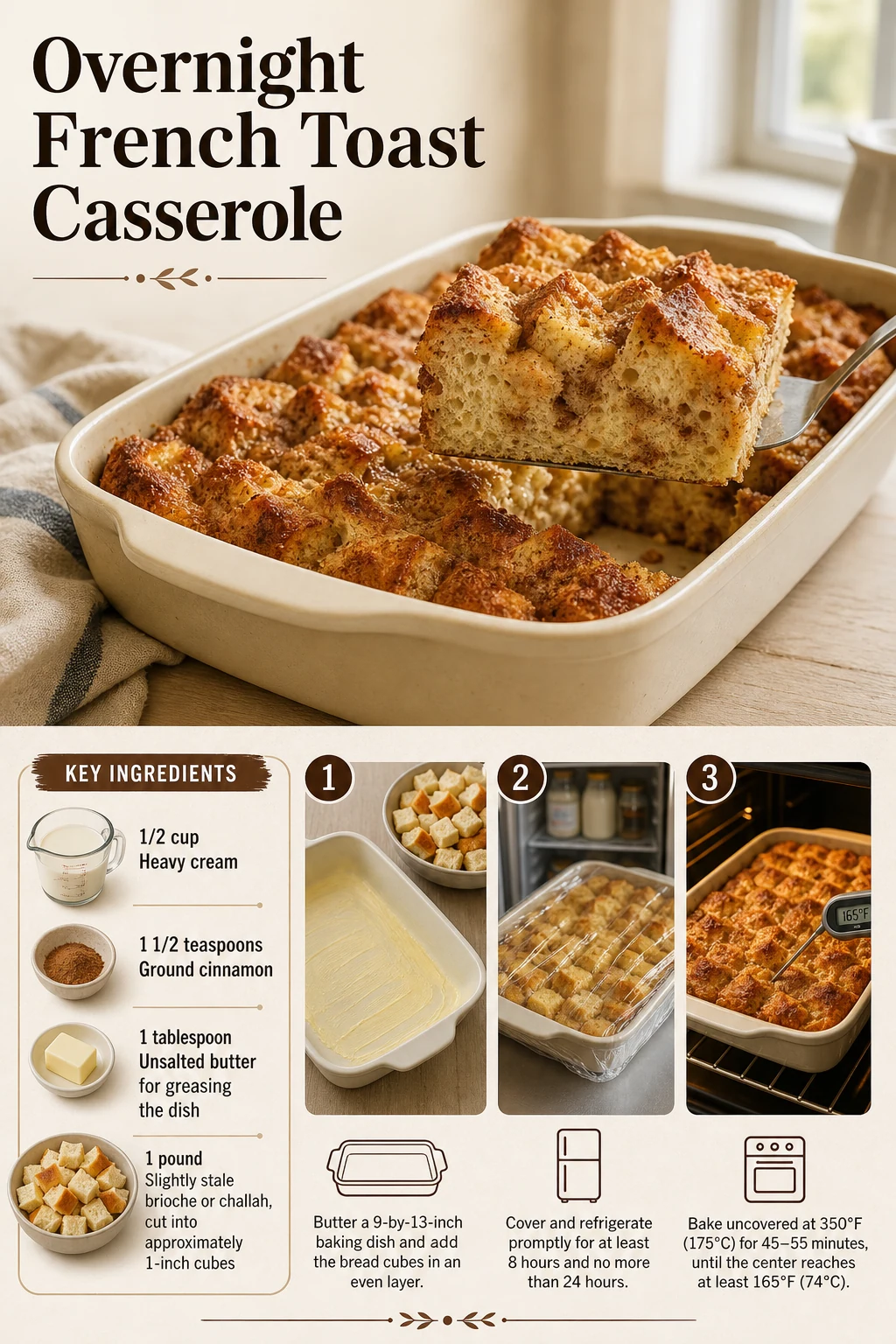
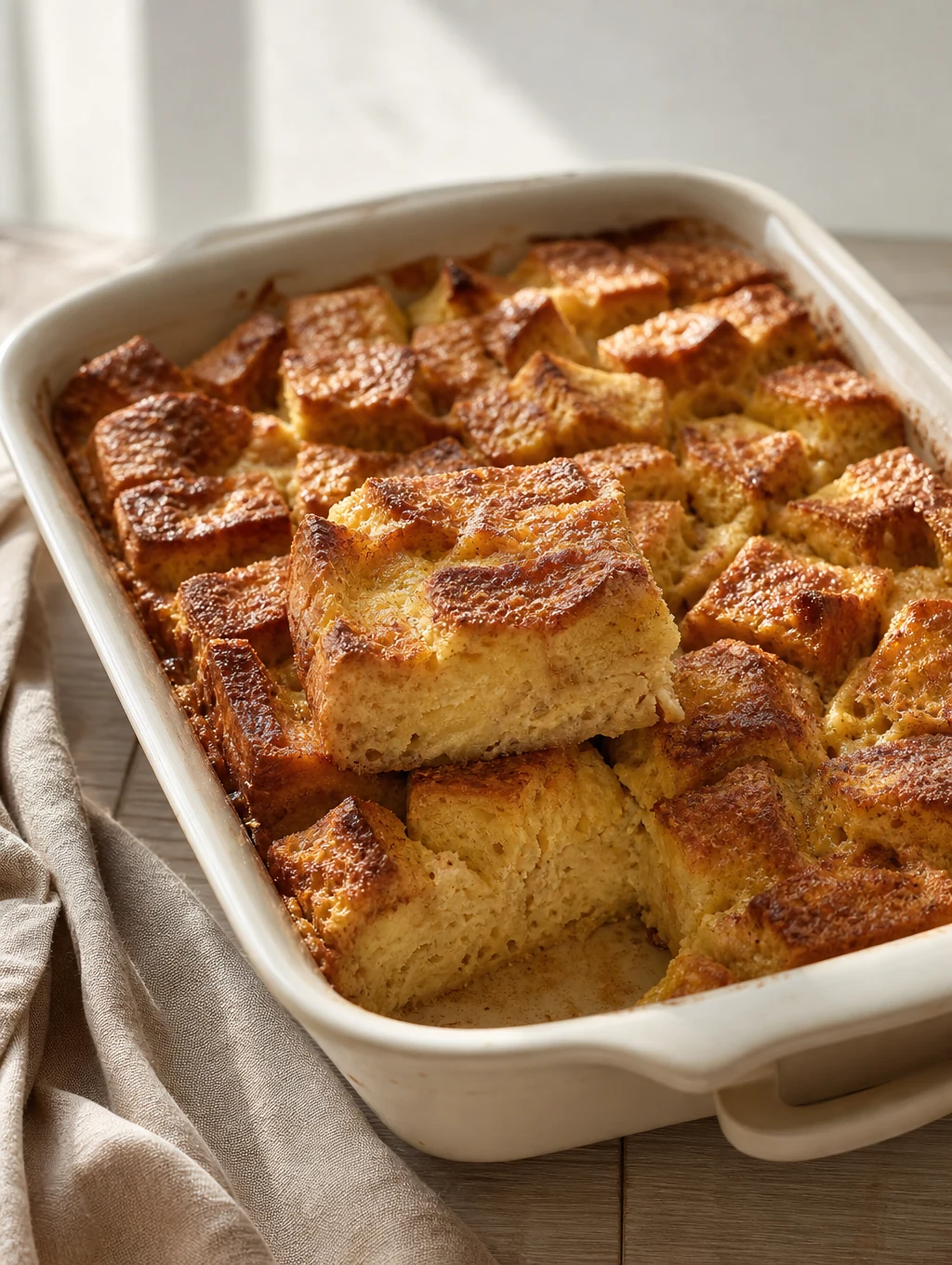
An overnight French toast casserole shifts most of the mixing to the evening before a holiday brunch. Cubes of slightly stale brioche or challah soak in a cinnamon-vanilla egg custard in the refrigerator, then bake into a golden top over a soft center. This working recipe is not kitchen-tested. The amount of liquid that a particular loaf absorbs, the pan depth and the center temperature all need checking before a final recipe or a photograph can promise the same result.
Jump to ingredients · Jump to method
Why prep it the night before?
The bread has time to absorb custard without a rushed soak on the morning guests arrive. An eight-hour refrigerated rest is built into the minimum working schedule, followed by about an hour for baking and resting. This is a sweet bread-and-custard dish, distinct from Chefly’s savory breakfast casserole with potatoes and spinach; the existing savory page explicitly has not tested its own overnight assembly, so that promise should not be borrowed for it.
The morning still requires an oven and a thermometer. A browned surface can hide an undercooked center, especially in a cold, deep baking dish. This draft uses a conservative 165°F center target for the casserole and calls for several checks rather than judging it by color alone.
Ingredients for a 9-by-13-inch dish
| Ingredient | Amount | Note |
|---|---|---|
| Slightly stale brioche or challah | 1 pound | Cut into roughly 1-inch cubes; fresh bread may absorb differently. |
| Large eggs | 8 | Whisk fully into the milk mixture. |
| Whole milk | 2 cups | Part of the custard. |
| Heavy cream | 1/2 cup | Adds richness; do not assume another dairy product behaves identically. |
| Packed light brown sugar | 1/2 cup | Whisk to disperse rather than leave clumps. |
| Vanilla extract | 2 teaspoons | Custard flavor. |
| Ground cinnamon | 1 1/2 teaspoons | Whisk thoroughly so the spice is distributed. |
| Fine salt | 1/4 teaspoon | Balances sweetness. |
| Unsalted butter | 1 tablespoon | For greasing the baking dish. |
Use a 9-by-13-inch baking dish, a large bowl, a whisk, foil and a clean food thermometer. Record the actual bread brand and cubed weight in the first test. Different loaf shapes can fill the same pan to different depths and change the bake time.
Evening assembly and morning bake
- Fill the dish. Butter the baking dish and spread the approximately one-inch bread cubes evenly. Avoid packing them down tightly; the custard needs a path through the gaps.
- Make the custard. Whisk the eggs, milk, cream, brown sugar, vanilla, cinnamon and salt until the sugar is dispersed. Pour across the bread, not just into one corner. Press the top pieces gently into the liquid without crushing them.
- Refrigerate promptly. Cover and place the raw-egg mixture in the refrigerator for a working 8- to 12-hour soak. USDA egg-dish guidance says dishes containing raw eggs should be cooked immediately or refrigerated and cooked within 24 hours. Do not leave the assembled pan on the counter overnight.
- Bake. Heat the oven to 350°F (175°C). Take the dish out only while preparing to bake; do not hold the raw casserole at room temperature for an extended time. Bake uncovered for an estimated 45 to 55 minutes. Tent loosely with foil if the top darkens too fast. Check the center in several spots with a thermometer, avoiding the pan, until the casserole reaches at least 165°F (74°C). A deeper or colder pan may take longer.
- Rest and portion. Let the casserole stand for 10 minutes, then divide into 12 portions. Record whether the center sets without drying the edges and whether portions lift cleanly.
The minimum working elapsed time is 570 minutes: 25 minutes to assemble, 480 minutes refrigerated soaking, approximately 55 minutes in the oven and 10 minutes to rest. A 12-hour soak adds four more hours. It is not a quick 25-minute breakfast, and bake time remains an estimate until tested.
What to watch in the first test
The top is brown but the center is wet
Protect the surface with foil and continue baking, checking several center points. Avoid declaring it done because a knife looks mostly clean; use the thermometer endpoint. Note pan material and bread depth for the final directions.
Dry top pieces after the overnight rest
Press them gently into the custard at assembly. On the test morning, note which pieces remained dry and whether the bread-to-custard ratio should change. Do not add an unmeasured splash of milk to the published recipe without retesting its cooking time.
The middle becomes heavy or soggy
Check that the bread was slightly stale and the cubes were about one inch. Record whether the center reached its safe temperature and how it sets after resting. A different bread can alter texture significantly even at the same one-pound weight.
Serving, variations and leftovers
Serve warm as a sweet brunch main, with fruit alongside if desired. Maple syrup can be offered at the table, but it is not included in the base recipe or nutrition. Nut toppings, citrus zest or berries would need quantities and a separate test before appearing in ingredient-driven images. Brioche and challah may already contain egg and dairy; check the actual loaf label for allergens.
Refrigerate perishable leftovers promptly rather than leaving the dish out for the entire brunch. USDA leftovers guidance calls for refrigeration within 2 hours, or within 1 hour above 90°F, and reheating leftovers to 165°F. Test whether a covered oven reheat preserves an enjoyable texture; no untested freezer or multi-day quality promise is made here.
Common questions
Can I soak it longer than 12 hours?
USDA’s raw-egg guidance says to refrigerate and cook within 24 hours. The preferred 8- to 12-hour window here is a texture hypothesis, not a tested shelf-life; a longer refrigerated soak may soften the bread too much.
Can I bake it straight from the refrigerator?
That is the working method. It may need more than the estimated 55 minutes depending on the cold dish, bread and oven. Use the center-temperature check; avoid thermal shock with a dish that is not rated for the transition.
Is it the same as the potato-and-spinach breakfast casserole?
No. This is a proposed sweet bread-and-custard recipe. The existing Chefly page is a savory potato-and-spinach dish and should remain an update to its own URL, not become a second version of this article.
Print
Overnight French Toast Casserole
- Total Time: 570 minutes
- Yield: 12 servings 1x
Description
Cubes of slightly stale bread soaked overnight in a cinnamon-vanilla egg custard and baked in a 9-by-13-inch dish.
Ingredients
- 1 pound Slightly stale brioche or challah, cut into approximately 1-inch cubes
- 8 whole Large eggs
- 2 cups Whole milk
- 1/2 cup Heavy cream
- 1/2 cup Packed light brown sugar
- 2 teaspoons Vanilla extract
- 1 1/2 teaspoons Ground cinnamon
- 1/4 teaspoon Fine salt
- 1 tablespoon Unsalted butter for greasing the dish
Instructions
- Butter a 9-by-13-inch baking dish and add the approximately 1-inch bread cubes in an even layer.
- Whisk eggs, milk, cream, brown sugar, vanilla, cinnamon and salt until the sugar is dispersed. Pour evenly over the bread, pressing gently so the top pieces contact the custard.
- Cover and refrigerate promptly for at least 8 hours and no more than 24 hours before cooking; follow cold-holding guidance for the raw egg mixture. The working preferred window is 8 to 12 hours and must be tested for the chosen bread.
- Heat the oven to 350 F (175 C). Remove the dish from the refrigerator while the oven preheats only as needed to prepare for baking; do not leave it sitting out. Bake uncovered approximately 45 to 55 minutes, tenting if the top darkens before the center cooks. Use a clean thermometer at several center points, avoiding the pan, to verify at least 165 F (74 C) for this casserole.
- Rest 10 minutes, then divide into 12 portions and serve. Refrigerate leftovers promptly and reheat them to 165 F (74 C).
Notes
Recipe-development draft; not kitchen-tested. Timing and yield are estimates. Nutrition has not been calculated.
Additional chilling, resting or cooling time: 490 minutes, included in the total.
Minimum development estimate: 8 hours refrigerated soaking plus 10 minutes resting; a 12-hour soak would add 4 hours. Bake time and absorption depend on bread and pan; do not leave raw egg mixture at room temperature.
- Prep Time: 25 minutes
- Chilling, resting or cooling: 490 minutes
- Cook Time: 55 minutes
Nutrition
- Serving Size: One twelfth of the baked 9-by-13-inch casserole